Mapungubwe and the Golden Rhino: Eight Centuries of African Goldsmithing
There is a small rhinoceros of thin gold foil, once nailed over a carved wooden core, that spent most of the twentieth century on the margins of South Africa’s official history. It is the Mapungubwe golden rhino, and it is now a national treasure. The reason it was left out is the reason it matters.
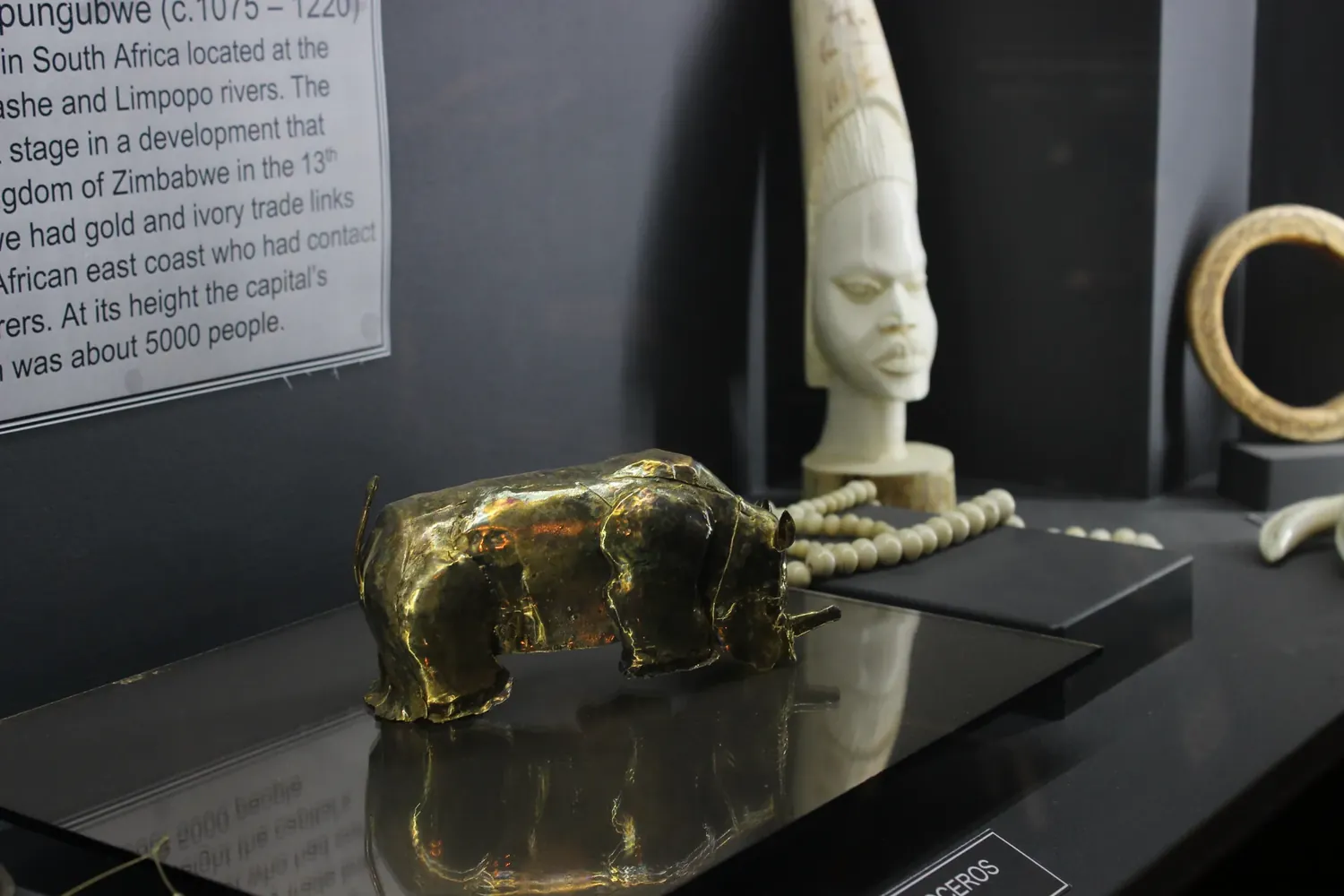
A king on a hill above the Limpopo
About a thousand years ago, a farming and trading community settled near a flat topped hill above the Limpopo River, close to where it meets the Shashe. Around 1220 its rulers moved up onto the summit, and for the rest of the thirteenth century Mapungubwe Hill was the capital of a kingdom that grew rich on cattle, farming and trade in gold, ivory and glass beads.
At its height it was the largest kingdom in the African subcontinent. Trade routes ran from the hill to the East African coast, and from the coast onward to Arabia, India and China. Chinese porcelain has been recovered from the site. So have Persian glass beads.
The rulers lived on top of the hill while everybody else lived below it, and as far as we can tell that is the first time in this region that kings were physically set apart from their people. UNESCO, which made the Mapungubwe Cultural Landscape a World Heritage Site in 2003, describes it as the first indigenous kingdom in southern Africa.
Then it emptied. After about 1300 the rains declined, the valley could no longer feed so many people, and power moved north to Great Zimbabwe. The hill was left alone for more than six hundred years.
The rhinoceros that did not fit
In the early 1930s, digging on the hilltop turned up gold. Not trade gold, worked gold. Three of the graves held gold in quantity: a bowl, sceptres, bangles, beads, and a small rhinoceros made by pressing gold foil over a carved wooden figure and fixing it with tiny gold nails.
For decades the find sat outside the country’s official story. Archaeologists knew about it and newspapers reported it, but it did not suit the version of the past that the government of the day wished to tell, one in which the country had been largely empty before European settlers arrived. A golden rhinoceros made by African goldsmiths in the thirteenth century is difficult to fit into that story.
In 1999 the rhinoceros was declared a national treasure, and since 2002 its likeness has sat at the centre of the Order of Mapungubwe, South Africa’s highest honour.
The replica in Space C sits beside real old ivory and original trade beads. What it establishes is simple enough. African goldsmithing is not a recent import. When some of the hilltop gold was dated directly, in research published in 2009, it proved to have been made while the hill was occupied, the product of what the researchers called a mature indigenous metalworking tradition. It is about eight hundred years old on this soil, and it was superb.
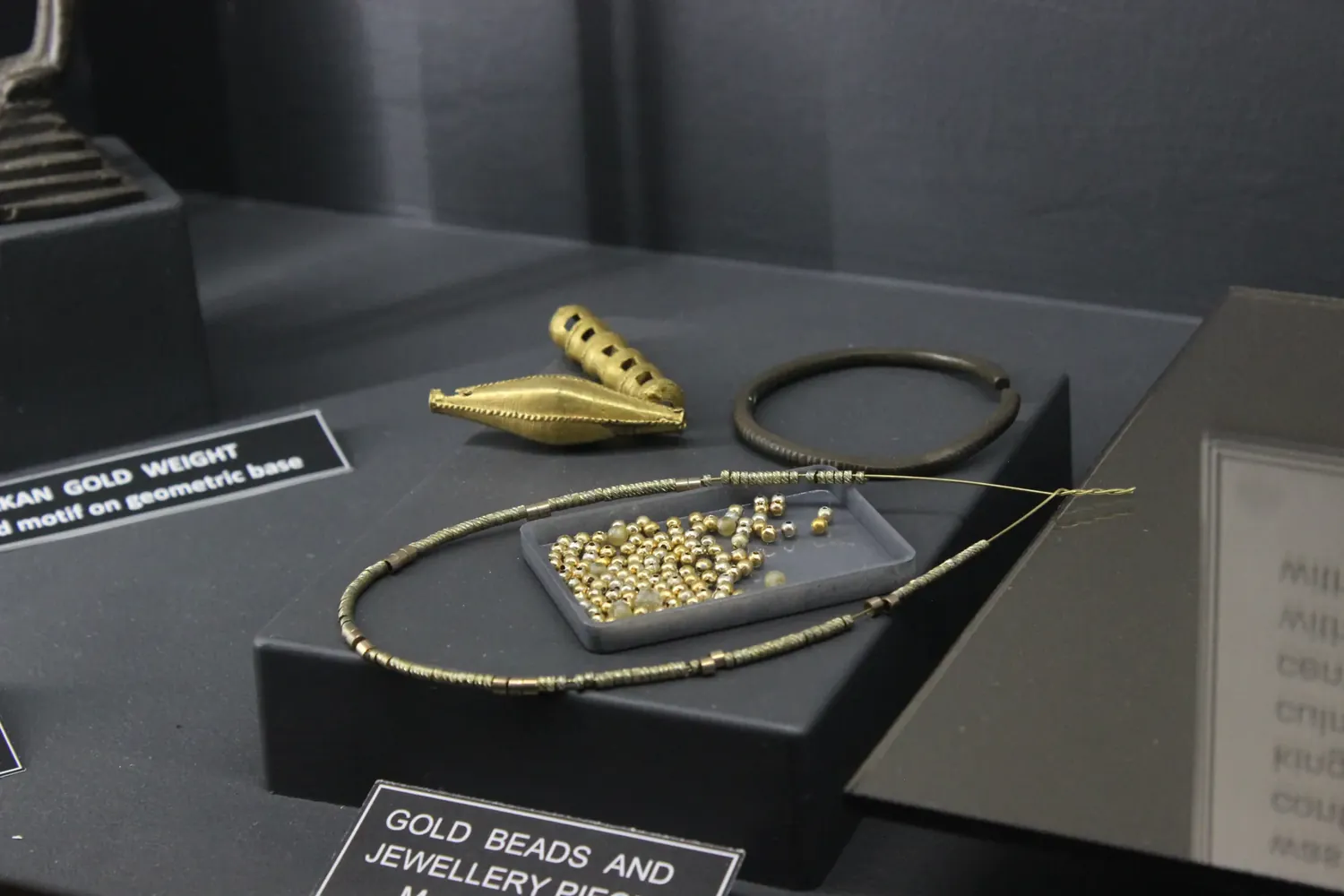
The beads that came before gold
The case alongside holds glass beads, and they carry a heavier history than you might expect.
At Mapungubwe and the earlier settlement nearby, imported glass beads were the mark of elite wealth until gold took their place in the thirteenth century. Across Africa, beads were never merely decorative. They signalled status, wealth, identity and belief, and for long stretches they worked as currency. By the sixteenth century many were coming from the glass workshops of Venice and Bohemia, to be carried deep inland and exchanged for gold and ivory, and West African bead makers produced their own as well.
Value was regional and specific. No single kind of bead was wanted in every market, so a trader had to learn the taste of each people the way a merchant studies a market today. When Henry Morton Stanley prepared his 1871 expedition in Zanzibar, he chose eleven kinds. Beads were strung, hoarded as wealth, inherited, and worn by kings, chiefs and priests as marks of rank.
They were also among the goods exchanged in the trade of enslaved people.
Both of those things are true of the same objects in the same case. Beauty and history are rarely tidy, and these have seen a great deal of both.
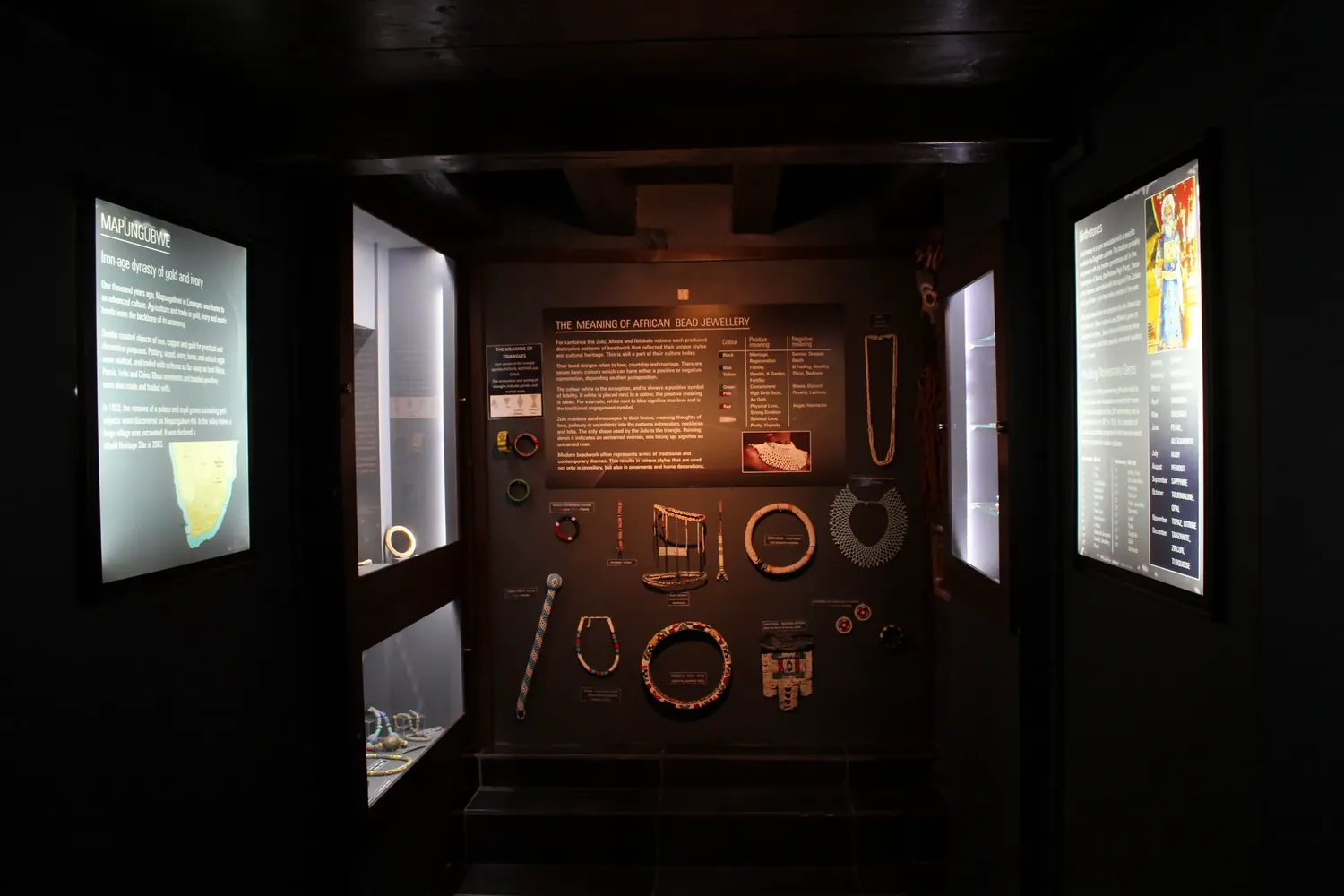
A love letter with no words in it
The next case teaches you to read.
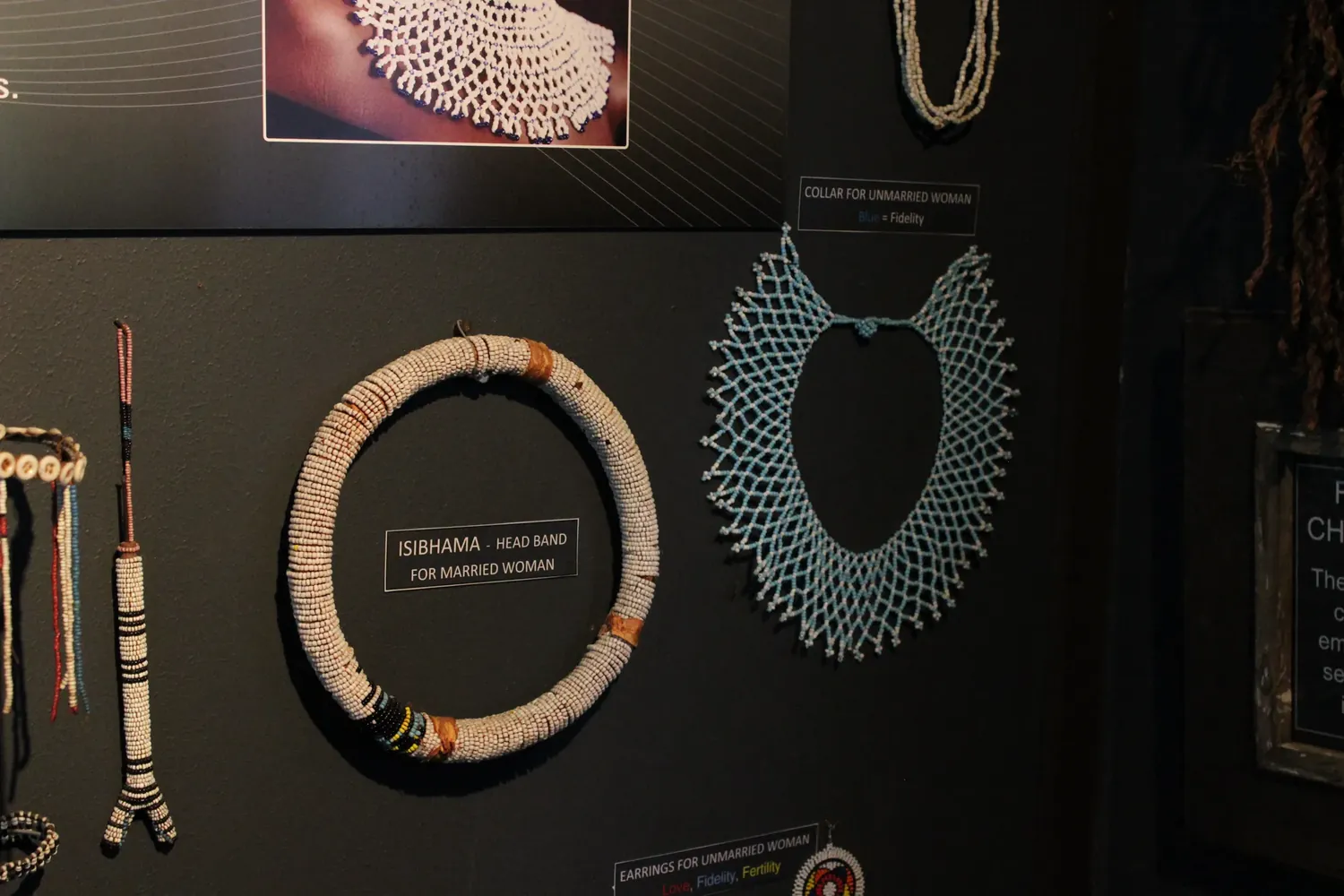
Among the nations of South Africa, beadwork carries meaning, and Zulu beadwork in particular carries a language of courtship. White can mean pure love. Red can mean the heat of longing. Black can mean marriage, and it can mean difficulty.
The subtlety is in the arrangement. The meaning of a single colour shifts depending on whether it sits beside a black bead or a white one. The same red says one thing in joy and something else in sorrow.
A young woman would work a message into a small beaded panel, an incwadi or love letter, and send it to the man she favoured, often by way of an older sister. He then had the delicate task of reading it correctly, in colours and patterns meant to be understood by the two of them alone.
So a beaded panel was courtship, secret code and artwork at once, and the case in Space C sets out the vocabulary so you can decode one yourself.
Long before anyone sent a text message, people found ways to get their feelings across a distance, in colour, in pattern, and in a great deal of patient handwork.
Why this space sits where it does
Space C comes before the diamond displays of Space D, and the order is worth noticing.
By the time you reach the polishing bench and the Cullinan replica, you have already seen that this continent was working precious materials with skill and meaning for a very long time. The diamonds are a chapter in that story rather than the beginning of it.
Seeing it for yourself
Space C, African Tribal Crafts, is the third space in the Museum of Gems & Jewellery at Huguenot House, 66 Loop Street, Cape Town. Entry is free and visits are by appointment. The audio guide, in English, tells these stories at displays C14 to C16, and Space B, just before it, goes back further still, to some of the oldest jewellery in the world.
Come and look at the rhinoceros, in replica. The original, in the University of Pretoria’s Mapungubwe Collection, is about fifteen centimetres long and weighs just 37.4 grams, small enough to sit in the palm of your hand, which is rather the point. Somebody made it by hand, on a hill above the Limpopo, in the same century that Magna Carta was sealed in England.
Sources:
UNESCO World Heritage Centre: Mapungubwe Cultural Landscape
Giblin (2016), The Conversation: Meet the 800-year-old golden rhinoceros that challenged apartheid South Africa
University of Pretoria Museums: International World Rhino Day: the one and only gold rhino in the world
Woodborne, Pienaar and Tiley-Nel (2009), Journal of African Archaeology: Dating the Mapungubwe Hill gold
Huffman (2015): Mapela, Mapungubwe and the origins of states in southern Africa
Princeton University Art Museum: Beading African History
Arms, Beads and Cloth project, University of Pavia: Choosing the right beads
Phansi Museum: Incwadi Yothando: the secret love language of beads
Continue your reading.

A Diamond Museum in Cape Town: Visiting the Museum of Gems & Jewellery
Forty displays, free entry by appointment: what to see at the Museum of Gems & Jewellery in Huguenot House.
Read article
Famous South African Diamonds: The Cullinan and Beyond
The Eureka, the Star of South Africa, the Cullinan diamond and the great Jagersfontein finds: the true stories of the diamonds that made South Africa famous.
Read article
From Mine to Ring: The Journey of a Diamond
Kimberlite pipes, cutting centres, grading labs and setting benches: how a rough crystal becomes the stone in a ring, and every hand it passes through.
Read article