Some of the Oldest Jewellery in the World Was Made in South Africa
The oldest jewellery in the world is not Egyptian. It is not Mesopotamian. Some of it came out of a cave on the Southern Cape coast, about three hundred kilometres east of Cape Town, and it is roughly seventy five thousand years old.
Blombos Cave, near Still Bay
Blombos Cave sits in a cliff above the sea near Still Bay, Stilbaai in Afrikaans, on the Southern Cape coast. Since the 1990s a team led by the archaeologist Christopher Henshilwood has been finding things there that reset the timeline of the human mind.
In 2002 they reported pieces of red ochre engraved with a deliberate cross hatched pattern, about 77,000 years old and among the oldest abstract designs anyone has recovered. In 2004 they reported the beads: small tick shells, each one pierced with a sharp bone point and worn smooth where it had rubbed against its cord and its neighbours. Some still carry traces of red ochre. They are about 75,000 years old. And in 2011 they described something older still, a workshop about 100,000 years old in which a paint rich in ochre was mixed and stored in two abalone shells, with the grindstones and hammerstones used to make it.
Somebody had strung those shells and worn them.
Older shell beads have since come to light in North Africa and the Near East. The oldest reported so far, from Bizmoune Cave in Morocco, are at least 142,000 years old. The Blombos beads remain among the earliest jewellery known anywhere, and they were made on this coastline.
Why a bead is a bigger deal than a tool
A stone tool tells you a person was hungry and clever. A bead tells you something far stranger.
To make one, a person had to picture an object that did not yet exist, then work towards it. They had to care how they looked to other people, which means they understood that other people held opinions about them. Archaeologists read that as evidence of symbolic thought, the foundation under language, art, trade, religion and every jewel made since.
The shell beads themselves are worth almost nothing. What they carry is a human being deciding to say something about themselves without speaking.
The cold and the sea
The people who sheltered at Blombos were living through the last great ice age. The coastline gave them shellfish, fish, seals and dolphins, a diet rich in protein, and there is a reasonable argument that this coastal larder is part of why the mind flowered here when it did.
They were not scratching out a bare existence in some cultural backwater. They were mixing paint, engraving ochre and stringing beads, tens of thousands of years before the famous painted caves of Europe such as Chauvet and Lascaux.
Three million years of hands
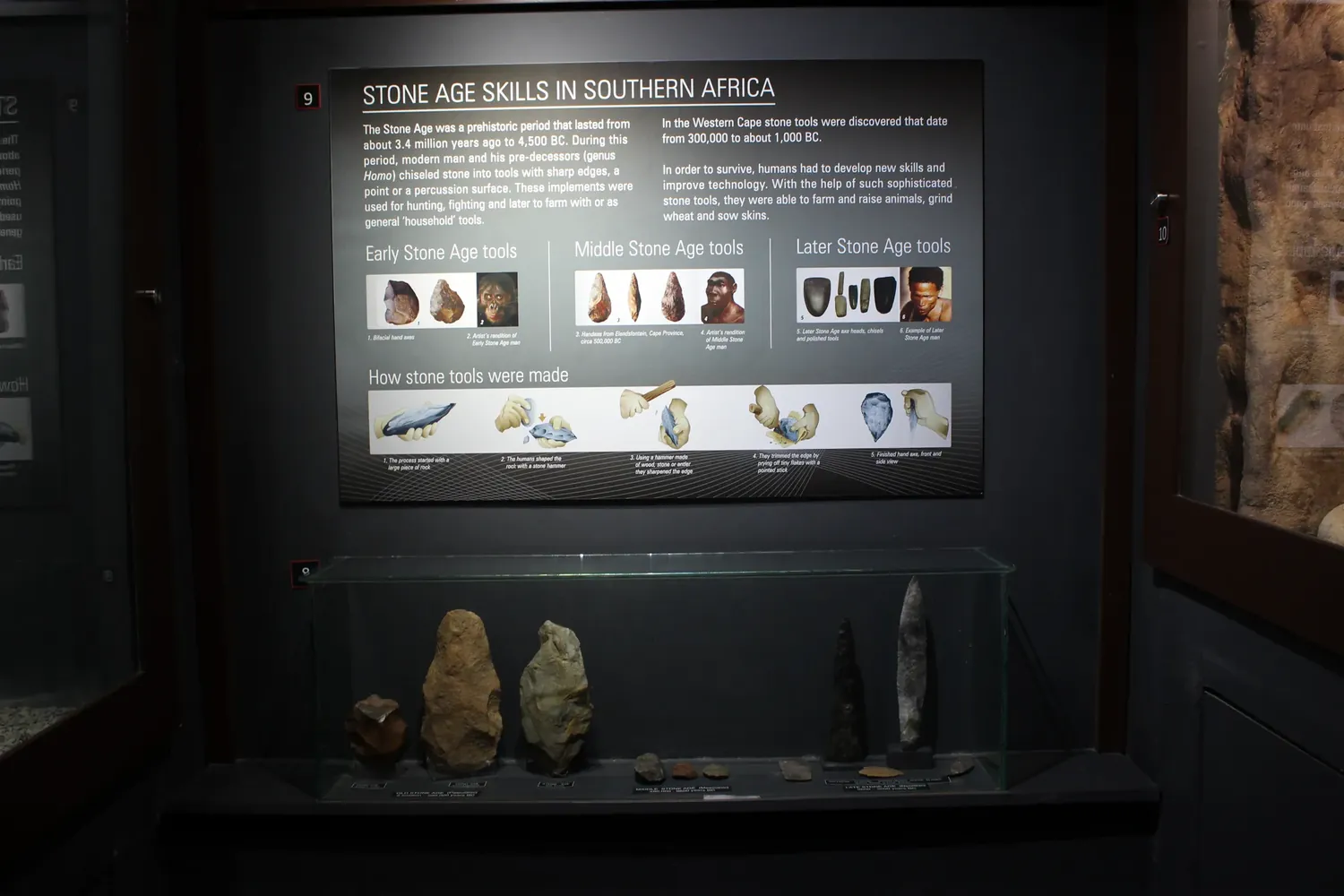
The Blombos beads sit inside a much longer story, and the museum lays it out in a single showcase.
For more than three million years our ancestors have shaped tools, first from stone and in time from bone and wood. In southern Africa, scholars divide that span into the Early, Middle and Later Stone Age, and you can watch the mind sharpen alongside the stone. The early pieces are blunt, chipped, held in the fist. The later ones show planning and symmetry, finely worked blades and spear points that are as much sculpture as instrument.
Every one of them was made by hand, without metal, by somebody who had to learn the craft from somebody before them.
That is the deepest root of the goldsmith’s bench, which you meet again further along the museum, in Space E. The same hands, the same patience, three million years of practice running all the way to the ring on your finger.
The San, and an art that endured
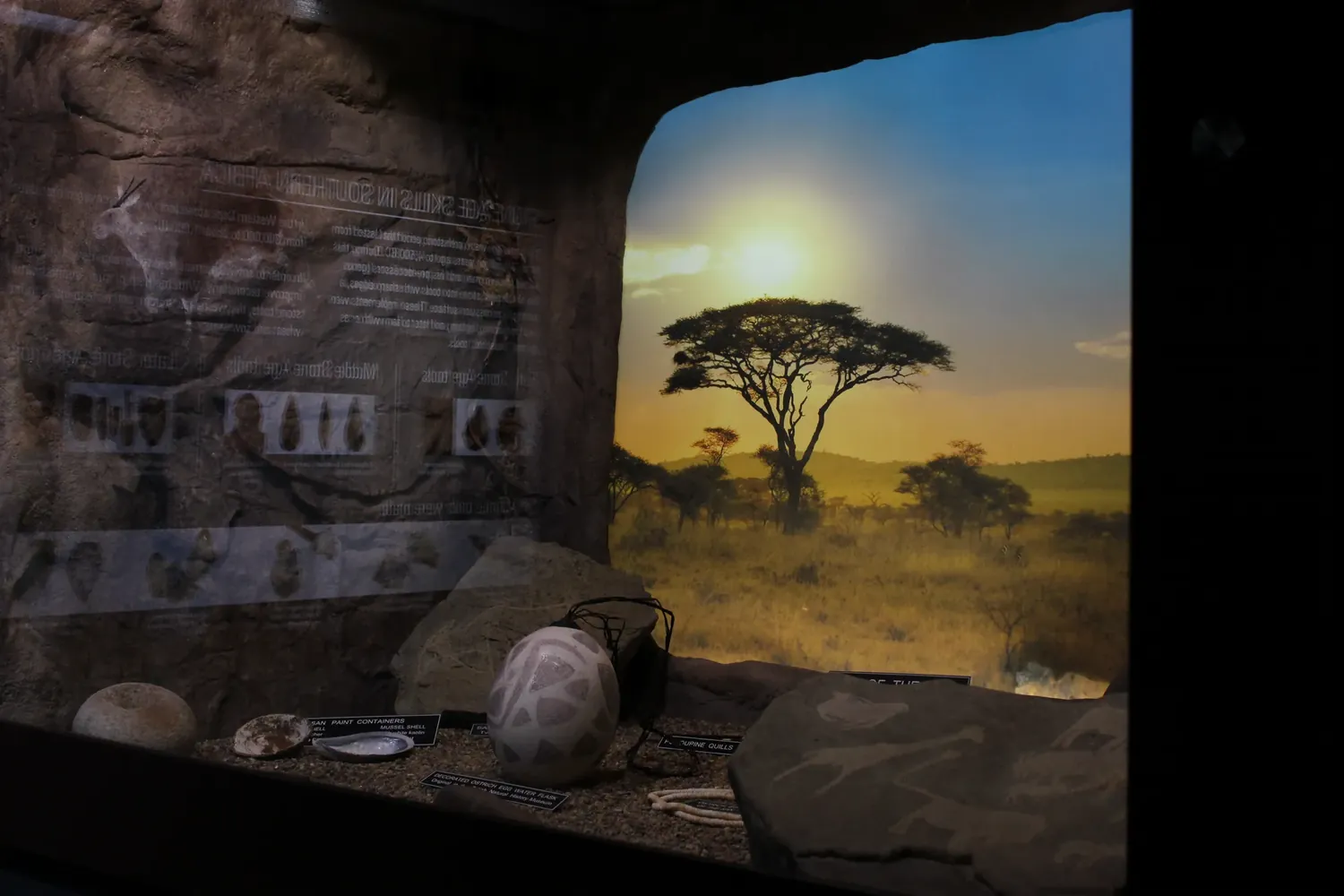
The rock art of the San is among the longest lived artistic traditions on earth. The oldest dated paintings of animals in southern Africa, from the Apollo 11 rock shelter in Namibia, are about 27,000 years old. Space B holds San tools alongside faithful copies of their engravings and paintings, and a replica of a decorated ostrich egg flask.
At a glance the images read as hunters and animals. They are considerably more than that. Many are bound up with the trance dance, in which healers travelled to the spirit world: the moment when the everyday world and the spirit world were held to touch. The eland appears again and again, the animal the San believed held more spiritual power than any other.
The artists used the rock itself. Figures seem to step in and out of cracks in the stone, as if through a veil between this world and the spirit world, and the animals are drawn by people who had watched them with extraordinary care.
One thing is worth holding on to as you look. The people who made these images have not vanished. Their descendants live in southern Africa today, and the San are among the oldest human lineages on earth.
Jewels that fell out of the sky
The last case in Space B turns from the ground to the sky.
Long before people learned to smelt iron from ore, they were gathering it from meteorites and working it into ornaments and blades. Iron beads from a grave at Gerzeh in Egypt, made around 3200 BC, are meteoritic, and so is the blade of a dagger buried with Tutankhamun. By the thirteenth century BC the Egyptians had a word for iron that translates as iron of the sky.
Then there are the tektites, moldavite among them, which have a stranger origin still. When a large meteorite strikes the earth, the impact melts the ground and throws droplets of molten rock into the air. They cool as they fall and harden into natural glass, sometimes mossy green, sometimes black.
Moldavite, the green kind, is found mainly in southern Bohemia in the Czech Republic and takes its name from the Vltava river, the Moldau in German. It was thrown there by the impact that made the Ries crater in southern Germany about fifteen million years ago, and it lies some two hundred to four hundred and fifty kilometres east of the crater. Stone Age people in the region picked it up and worked it into tools.
Two stories in one case, then. Metal that drifted here from the birth of the solar system, and glass forged in a single violent second when the sky met the ground.

Seeing it for yourself
Space B, the Cradle of Creativity, is the second space in the Museum of Gems & Jewellery at Huguenot House, 66 Loop Street, Cape Town. Entry is free and visits are by appointment. The audio guide, in English, covers this space in four displays, B10 to B13, and the story carries on in Space C with the Mapungubwe golden rhino.
The diamonds draw the eye. The shells deserve just as long a look.
Because that is the thing worth carrying home. Every jewel in the museum belongs to a story that runs back to pierced shells like these, strung on a cord in a cave on this coastline by somebody who had learned to imagine.
Sources:
Henshilwood et al. (2002), Science: Emergence of modern human behavior: Middle Stone Age engravings from South Africa
Henshilwood et al. (2004), Science: Middle Stone Age shell beads from South Africa
Vanhaeren et al. (2013), Journal of Human Evolution: Thinking strings: additional evidence for personal ornament use in the Middle Stone Age at Blombos Cave
Henshilwood et al. (2011), Science: A 100,000-year-old ochre-processing workshop at Blombos Cave, South Africa
Henshilwood et al. (2001), Journal of Archaeological Science: Blombos Cave, Southern Cape, South Africa: preliminary report on the 1992 to 1999 excavations of the Middle Stone Age levels
Sehasseh et al. (2021), Science Advances: Early Middle Stone Age personal ornaments from Bizmoune Cave, Essaouira, Morocco
Harmand et al. (2015), Nature: 3.3-million-year-old stone tools from Lomekwi 3, West Turkana, Kenya
Origins Centre, University of the Witwatersrand: What do you know about San rock art?
Lewis-Williams and Dowson (1990), South African Archaeological Bulletin: Through the veil: San rock paintings and the rock face
Schlebusch et al. (2017), Science: Southern African ancient genomes estimate modern human divergence to 350,000 to 260,000 years ago
Comelli et al. (2016), Meteoritics & Planetary Science: The meteoritic origin of Tutankhamun’s iron dagger blade
Skála et al. (2009), Geochimica et Cosmochimica Acta: Moldavites from the Cheb Basin, Czech Republic
Continue your reading.

A Diamond Museum in Cape Town: Visiting the Museum of Gems & Jewellery
Forty displays, free entry by appointment: what to see at the Museum of Gems & Jewellery in Huguenot House.
Read article
Famous South African Diamonds: The Cullinan and Beyond
The Eureka, the Star of South Africa, the Cullinan diamond and the great Jagersfontein finds: the true stories of the diamonds that made South Africa famous.
Read article
From Mine to Ring: The Journey of a Diamond
Kimberlite pipes, cutting centres, grading labs and setting benches: how a rough crystal becomes the stone in a ring, and every hand it passes through.
Read article