Can You Spot the Real Diamond? Five Stones, One Is Genuine
The last case in our museum is a small test of real diamond vs fake. It holds five polished stones. One is a diamond. The others are a cubic zirconia, a colourless sapphire, a gadolinium gallium garnet and a piece of clear quartz.
It is harder than it looks, and the obvious answer is the wrong one.
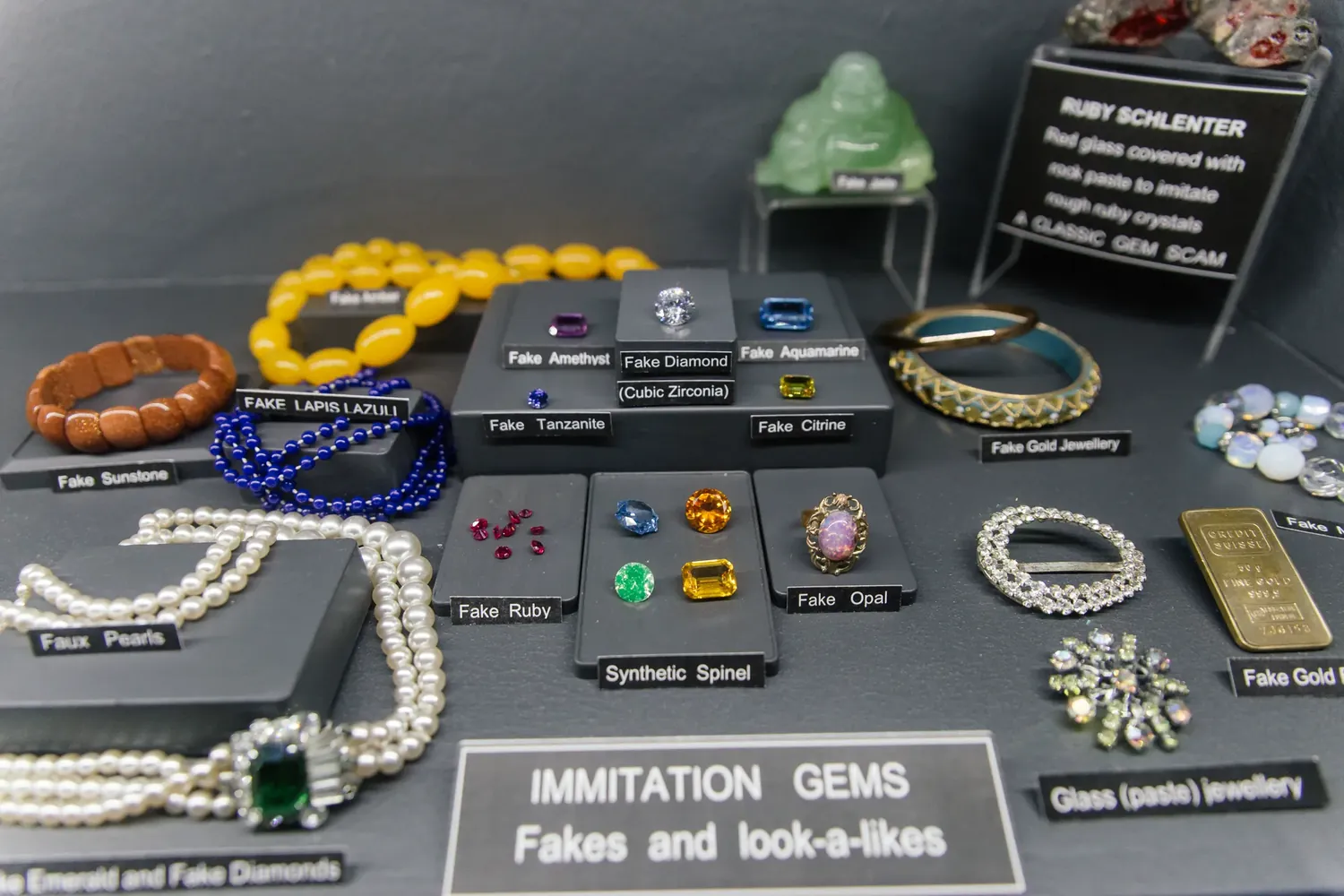
The tell most people miss
People look for the stone throwing the most fire. The brightest flashes of rainbow colour, the most dramatic sparkle.
That is the cubic zirconia.
A real diamond’s fire is fine, controlled and balanced. Cubic zirconia splits white light into colour more strongly than diamond does, and throws it in broad, showy flashes. The excess is the giveaway.
There is a second tell. Most diamonds in a jeweller’s window run from colourless to near-colourless, with slight hints of yellow or brown, and that faint warmth is normal rather than a defect. Cubic zirconia, by contrast, is often colourless and flawless. A stone that is aggressively, flawlessly white is worth a second look.
In gemmology the fake tends to try too hard, while the real thing carries itself with restraint.
Grown and imitated are not the same thing
This distinction matters commercially and it confuses a great many buyers.
A laboratory grown diamond has essentially the same chemistry, crystal structure and physical properties as a mined one. It is a real diamond in every physical sense. What differs is origin, and therefore rarity: a lab grown diamond can be made on demand, while a natural one formed deep in the earth, in some cases as long as three billion years ago. Telling the two apart takes laboratory instruments. To the eye, and to an old-style diamond detector, they look the same.
An imitation only copies the appearance. Cubic zirconia, moissanite and ordinary glass can all sparkle convincingly to an untrained eye, and underneath they are entirely different materials.
Moissanite is the most convincing of them. It is synthetic silicon carbide, and at 9.25 on the Mohs scale it is hard enough to wear well, though diamond, at 10, is harder still. It shows even more fire than cubic zirconia, and it is doubly refractive, so under a loupe the facet edges at the back of the stone look doubled. For the buying side, read what South African buyers should know about moissanite.
Grown diamonds and imitations both have a legitimate place. What matters is that a buyer knows which one they are holding, because the value of each is worlds apart. A buyer deserves to know whether a stone was born in the earth, grown in a factory, or simply made to resemble the real thing. That principle sits at the centre of gemmology and of honest trade.
For the full comparison of grown and mined stones, read our honest look at lab grown and natural diamonds, and for the gemmologist’s methods, how to spot the difference between natural and lab grown diamonds.
Stones that genuinely do something strange
Some gems handle light in ways that look like a trick and are not. Gemmologists call these the phenomenal stones, and Space E has a case of them.
A star can glide across the dome of a sapphire or ruby, usually with six rays, moving as you move. The effect is called asterism.
A cat’s eye holds a single band of light that slides across the stone like the slit of a cat’s pupil.
Alexandrite changes colour outright, green in daylight and red under lamplight, as though somebody swapped the stone while you blinked.
Opal shifts its play of colour as it turns, and labradorite wakes into a flash of colour, most often a deep blue, from certain angles.
Most of these effects come from tiny, ordered structures inside the stone, most of them too small to see with the naked eye: fine needles or channels aligned in precise directions for the stars and cat’s eyes, tightly packed spheres of silica in opal, thin layers in labradorite. Alexandrite is the exception, because its change comes from the way the stone absorbs light. The thing that makes these gems seem alive is a hidden order inside them.
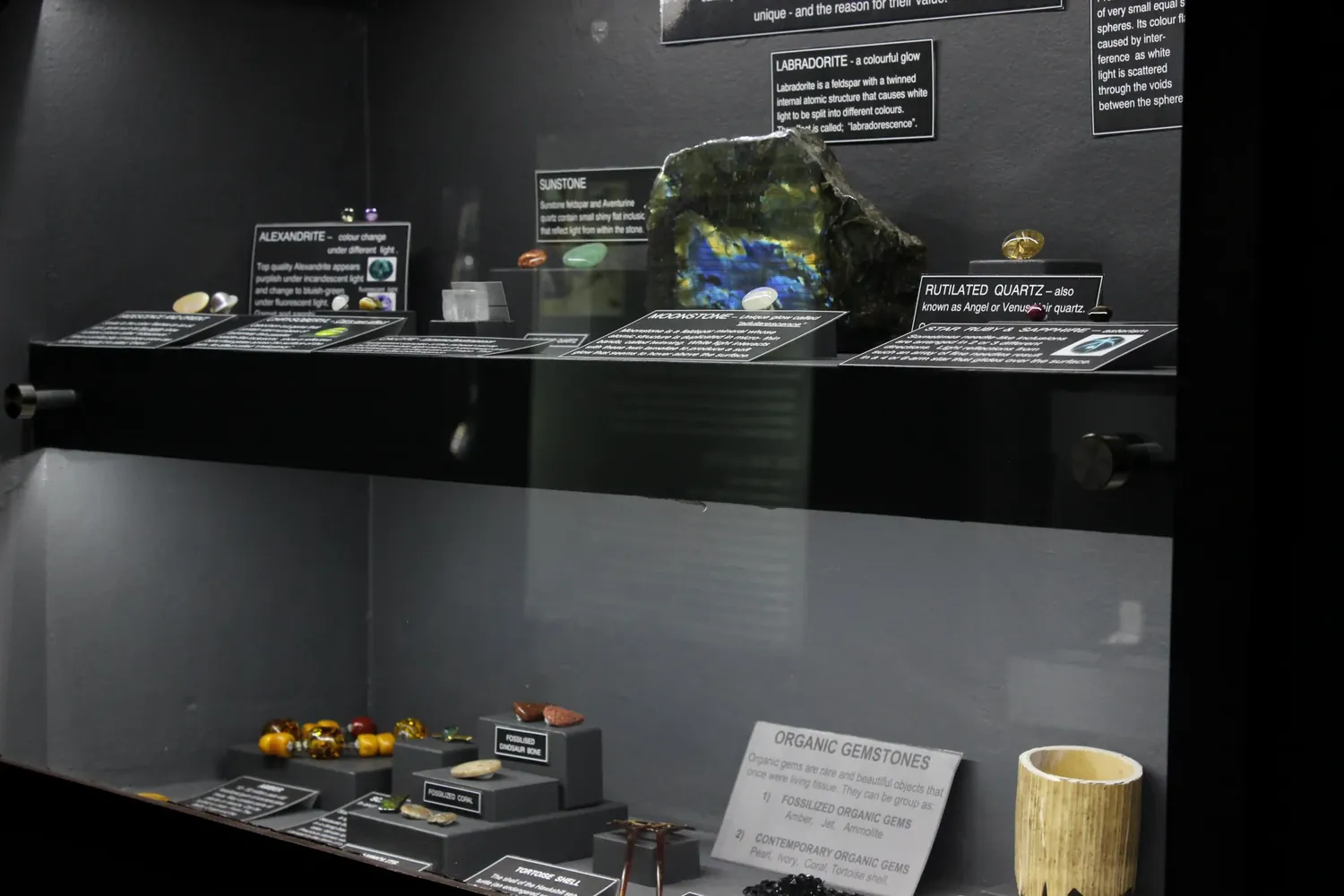
The gems that were once alive
Most gems are minerals, formed in the earth over immense spans of time. A few come from living things.
Pearls grow inside molluscs. A microscopic irritant works its way into an oyster or mussel, the creature cannot expel it, so it begins wrapping it in thin layers of nacre, the same lustrous material that lines its own shell. Layer upon layer builds up. The soft glow comes from light playing through all those delicate layers.
Natural pearls were once so rare that only royalty and the very wealthy could afford them. Today’s cultured freshwater pearls are known for their range, in shapes, in sizes and in natural pastel colours from white through pink and peach to lavender.
Coral is neither plant nor stone, but a skeleton built, grain by grain, by colonies of tiny sea animals called polyps.
Amber is tree resin that hardened and lay buried for millions of years. Occasionally it holds an insect or a leaf, perfectly preserved, a single moment of the deep past caught like a photograph.
Jet, common in Victorian mourning jewellery, is a dense form of fossil wood, a hard variety of lignite coal.
Ivory comes from animal tusks, and its trade is now strictly limited to protect the animals it once cost.
There is a quiet lesson in the pearl. Beauty is sometimes just the answer a living thing finds to a small and patient irritation.
How can you tell if a diamond is real?
Train your eye on fire and colour, then let a gemmologist’s instruments or a laboratory report give the verdict. No single look or gadget settles it on its own.
Look at fire and ask whether it seems proportionate. Gemmologists measure it as dispersion: about 0.044 for diamond, 0.058 to 0.066 for cubic zirconia and 0.104 for moissanite. Colourless sapphire and quartz show far less fire than diamond, while gadolinium gallium garnet shows almost exactly the same, so fire is a clue rather than proof.
Look at colour, remembering that slight warmth is normal in a natural diamond and that perfect whiteness proves nothing on its own. Compare stones side by side wherever you can, because the eye judges best by comparison.
Hardness separates them too, though it is not a test to try at home. Diamond scores 10 on the Mohs scale, moissanite 9.25 and cubic zirconia 8 to 8.5, which is why cubic zirconia scratches more easily than diamond.
Be wary of quick gadgets. A basic thermal tester reacts to moissanite as if it were diamond, because the two handle heat so similarly, and old-style diamond detectors cannot tell a lab grown diamond from a natural one at all.
Then ask for the report. A laboratory such as GIA tests every diamond it receives to establish whether it is natural or laboratory grown, and a reputable jeweller tells you without being asked. If a seller is vague about origin, that vagueness is the answer.
Handling stones in person is worth more than any amount of reading. That is precisely why the final case exists.
Come and take the test
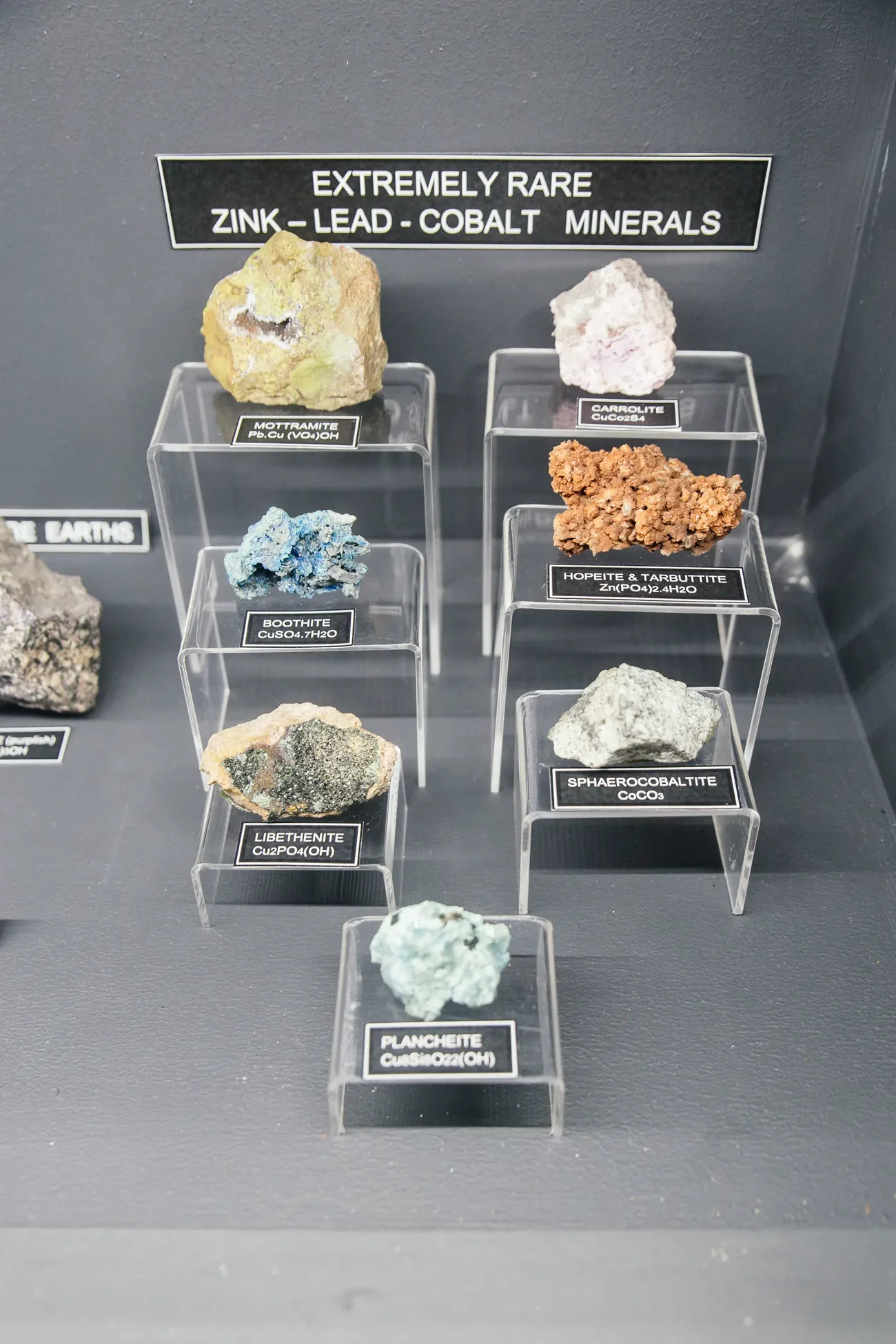
Space E is the last space in the Museum of Gems & Jewellery at Huguenot House, 66 Loop Street, Cape Town. Entry is free and visits are by appointment, so book your visit first. An English audio guide leads you case by case.
Go and stand in front of the five stones before you read the answer beside the case. Then look again at stone number two.
Frequently asked
How can I tell a real diamond at home?
You can gather clues, not proof. Compare fire against a known diamond if you can, because broad rainbow flashes suggest cubic zirconia. A basic thermal tester will not catch moissanite, so for certainty use a gemmologist or a laboratory report.
Is a lab grown diamond a real diamond?
Yes. It has essentially the same chemistry, crystal structure and properties as a natural diamond. It differs in origin and rarity, and therefore in value, and only a gemmological laboratory or specialised screening instruments can reliably tell the two apart.
Is moissanite a diamond?
No. It is synthetic silicon carbide, a different material that imitates the look. It is softer than diamond, shows more fire and is doubly refractive.
Does a real diamond have colour?
Usually a little. Most diamonds sold in jewellery shops run from colourless to near-colourless with slight hints of yellow or brown, and the less colour a diamond has, the higher its value.
What is asterism?
The star effect that glides across some sapphires and rubies, usually with six rays, caused by fine needles of another mineral, often rutile, lying in two or three directions inside the stone.
Are pearls gemstones?
Yes, organic ones, made by living molluscs rather than formed in the earth.
Sources:
Gemological Institute of America, Gems & Gemology: Synthetic Moissanite: A New Diamond Substitute
Gemological Institute of America, Gems & Gemology: Cubic Zirconia: An Update
Gemological Institute of America: What Are Simulated Diamonds?
Gemological Institute of America: Is There a Difference Between Natural and Laboratory-Grown Diamonds?
Gemological Institute of America: GIA 4Cs Color
Museum of Fine Arts, Boston (CAMEO): Gadolinium gallium garnet
Gemological Institute of America: Guide to Phenomenal Gems
Gemological Institute of America: Alexandrite
Gemological Institute of America: Pearl
Gemological Institute of America: History of Cultured Pearls, Part 1
Gemological Institute of America: Freshwater Pearls vs. Saltwater Pearls: Understanding the Difference
Gemological Institute of America: Captivated by Coral
Natural History Museum, London: Ancient insects trapped in amber discovered in South America for the first time
Gemological Institute of America: Historical Reading List: Mourning Jewelry, Whitby Jet
CITES: Ivory sales get the go-ahead
Continue your reading.

Engagement Rings in Cape Town: The Complete Buyer's Guide
Where to shop, what to spend and how to read a diamond certificate when you buy an engagement ring in Cape Town.
Read article
Diamond Prices in South Africa, Explained by Carat
Why one carat costs more than two half carats, and how colour, clarity and cut move diamond prices in South Africa.
Read article
Pre-Owned Jewellery in Cape Town: A Guide for Buyers and Sellers
Where to sell a diamond ring in Cape Town, how pre-owned pieces are valued and what to check before you buy.
Read article