Are “glow in the dark” diamonds more expensive than diamonds that do not fluorescence?
Every now and then, a client notices something unexpected. A diamond that appears perfectly ordinary indoors suddenly reveals a soft blue glow under ultraviolet light or direct sunlight. The immediate reaction is often concern: is this a flaw, a defect, or something that lowers the diamond’s value?
This phenomenon is known as fluorescence, and for much of diamond history it was regarded very differently to how it is today.
In the past, diamonds with strong blue fluorescence were known in the trade as “blue whites” and were considered especially desirable. Their inner glow enhanced the appearance of whiteness, and such diamonds often commanded a premium. Today, however, many fluorescent diamonds are sold at a discount. Why the change?
Although only 2–3% of diamonds with very strong fluorescence appear “milky” or “oily” when exposed to direct sunlight — an effect caused by ultraviolet light emitted by the sun — parts of the trade began discounting all diamonds with fluorescence. This broad approach ignores the fact that the overwhelming majority of fluorescent diamonds show no negative visual effect whatsoever.
As diamond pricing became increasingly transparent online, with consumers comparing certified diamonds based on the traditional 4Cs, the trade introduced additional factors to complicate pricing structures. Fluorescence, particularly its intensity and its interaction with body colour, became one such factor.
In general, a colourless diamond with strong blue fluorescence is often discounted, while blue fluorescence in a slightly yellowish diamond may actually improve its face-up appearance and add value by making the diamond appear whiter.
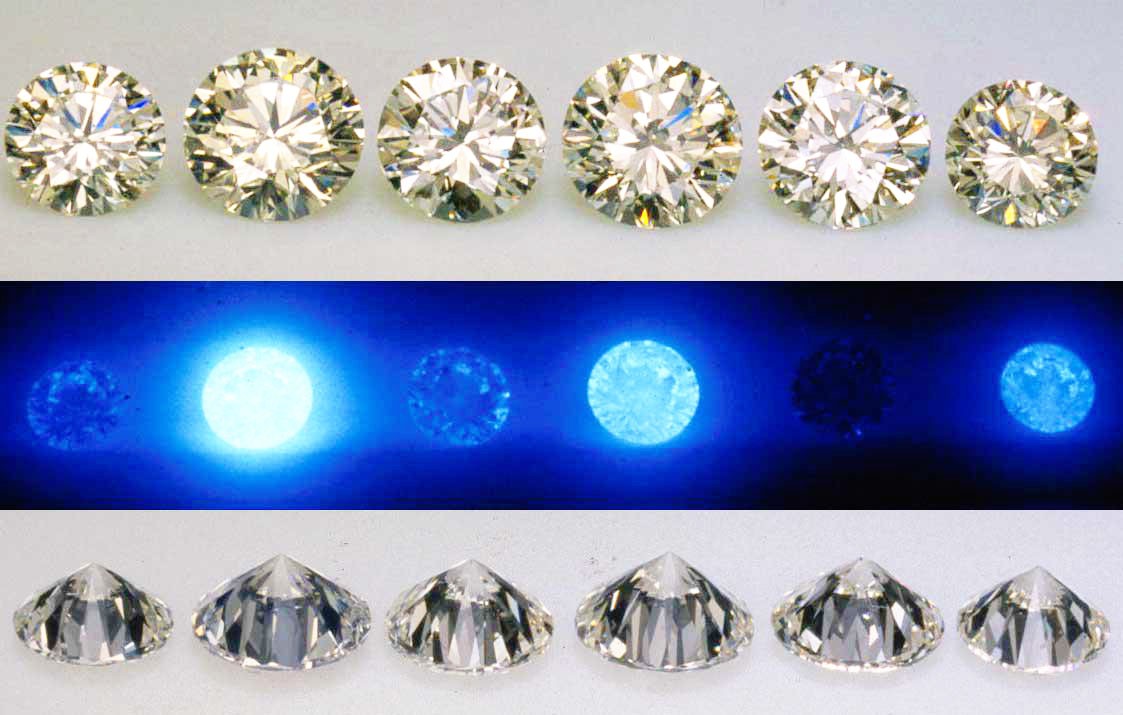
At Prins & Prins, our gemmologists maintain that only those 2–3% of fluorescent diamonds that exhibit a milky or oily appearance in direct sunlight warrant any form of discount. In all other cases, fluorescence is simply a natural characteristic — and in many diamonds, an advantage.
The subtle inner glow of a fluorescent diamond sets it apart from non-fluorescent diamonds and adds to its individuality. As awareness grows and misconceptions fall away, more clients recognise that blue fluorescence is a rare, natural, and often beautiful feature that can enhance the appearance of a polished diamond.
In conclusion, fluorescence is not a defect but a characteristic that must be understood in context. When properly evaluated, a diamond that “glows in the dark” may not only rival its non-fluorescent counterparts but may once again be appreciated as it was in the past — as one of the rarest expressions of nature’s craftsmanship.