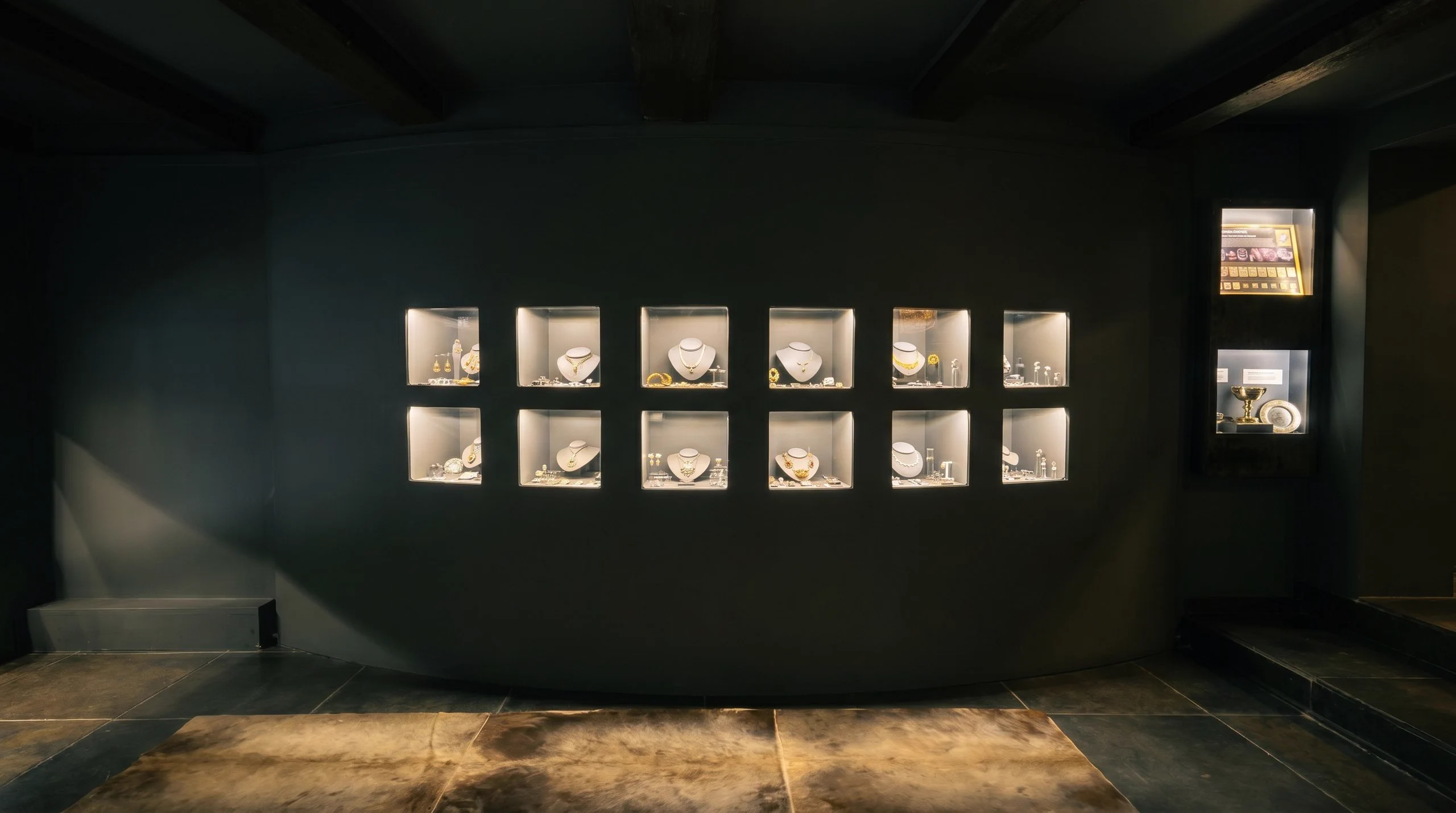
The lit display niches of the gallery wall at the Prins and Prins Museum of Gems and Jewellery, Cape Town

Ten Thousand Years of Jewellery,
one quiet space in Cape Town.

40k yrsStone Age to Art Deco 1075Mapungubwe Iron-Age Gold 3,106 ctThe Cullinan Diamond Story 4Historical Jewellery Eras 8+Rare African Minerals 272Krugerrand Miss World Gown 200mgThe Carob Origin of the Carat Dr PrinsBy Personal Appointment
A Private Collection

The Prins & Prins Museum of Gems & Jewellery is a private collection, curated over fifty seven years by Dr Petré Prins. It traces forty thousand years of southern African craftsmanship, the geology that built our gem economy, and three centuries of European jewellery. Every piece is studied, catalogued and on quiet permanent display.

Most of Cape Town walks past Huguenot House every day. Almost no one knows of the museum in its cellar.

Book a Tour or Private Viewing  →
Part One  ·  Three Centuries of Jewellery

Ten Thousand Years of Jewellery.
A short walk from The Georgian to the Art Deco Period.

Each cabinet a Period. The zeitgeist of each Period is reflected by its jewellery.

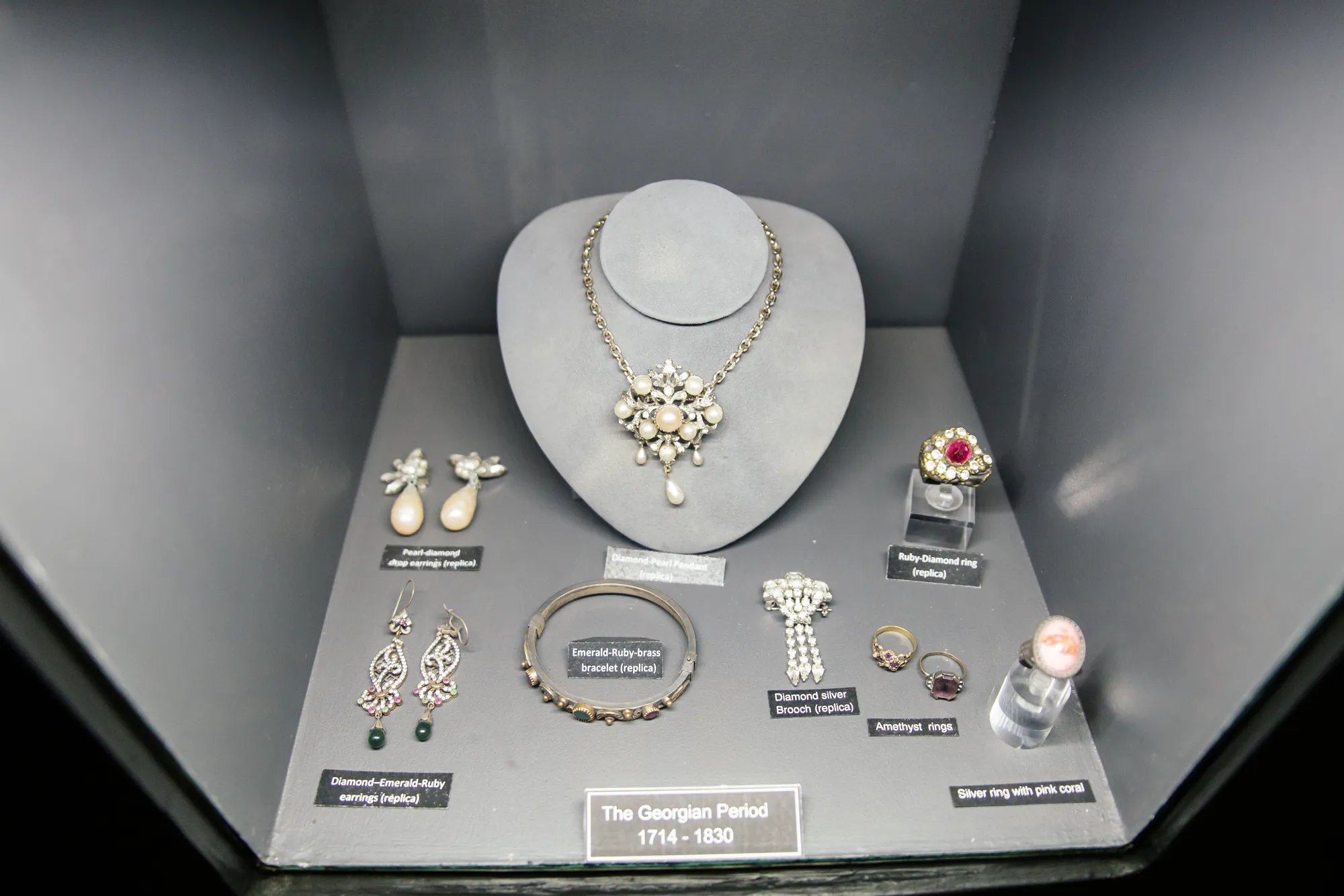
The Georgian Period display case in the museum (1714 to 1830): Diamond-Pearl Pendant on a velvet neck form, Pearl-Diamond drop earrings, Diamond-Emerald-Ruby drop earrings, Emerald-Ruby brass bangle, Diamond Silver Brooch, Ruby-Diamond cluster ring, Amethyst rings and a Silver ring with pink coral
Chapter I

1714  ◆  1830

The Georgian Period
Restraint and seed pearls.

Old-cut diamonds set in silver over gold, foiled stones for candlelit colour, and the first pavé seed pearls. Georgian jewellers worked slowly, every piece unique.
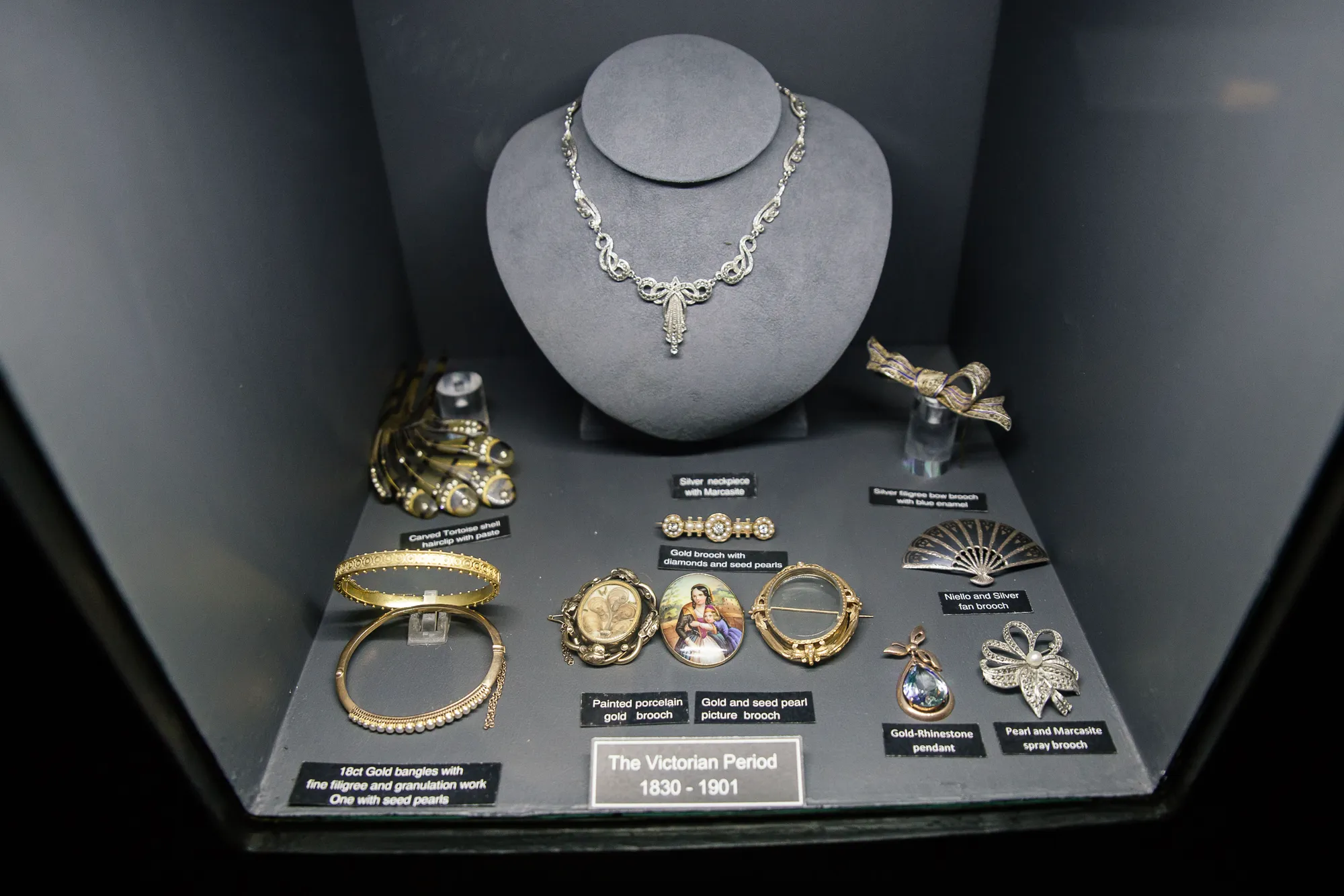
The Victorian Period display case in the museum (1830 to 1901): silver neckpiece with marcasite, 18ct gold bangles with filigree and seed pearls, painted-porcelain gold brooch, gold and seed-pearl picture brooch, niello and silver fan brooch, gold-rhinestone pendant and pearl-and-marcasite spray brooch
Chapter II

1830  ◆  1901

The Victorian Period
Sentiment in granulation.

An empire's worth of taste expressed in 18ct gold filigree, marcasite night-wear, painted porcelain miniatures and the language of mourning. Queen Victoria wore black for forty years and the jewellers obliged.

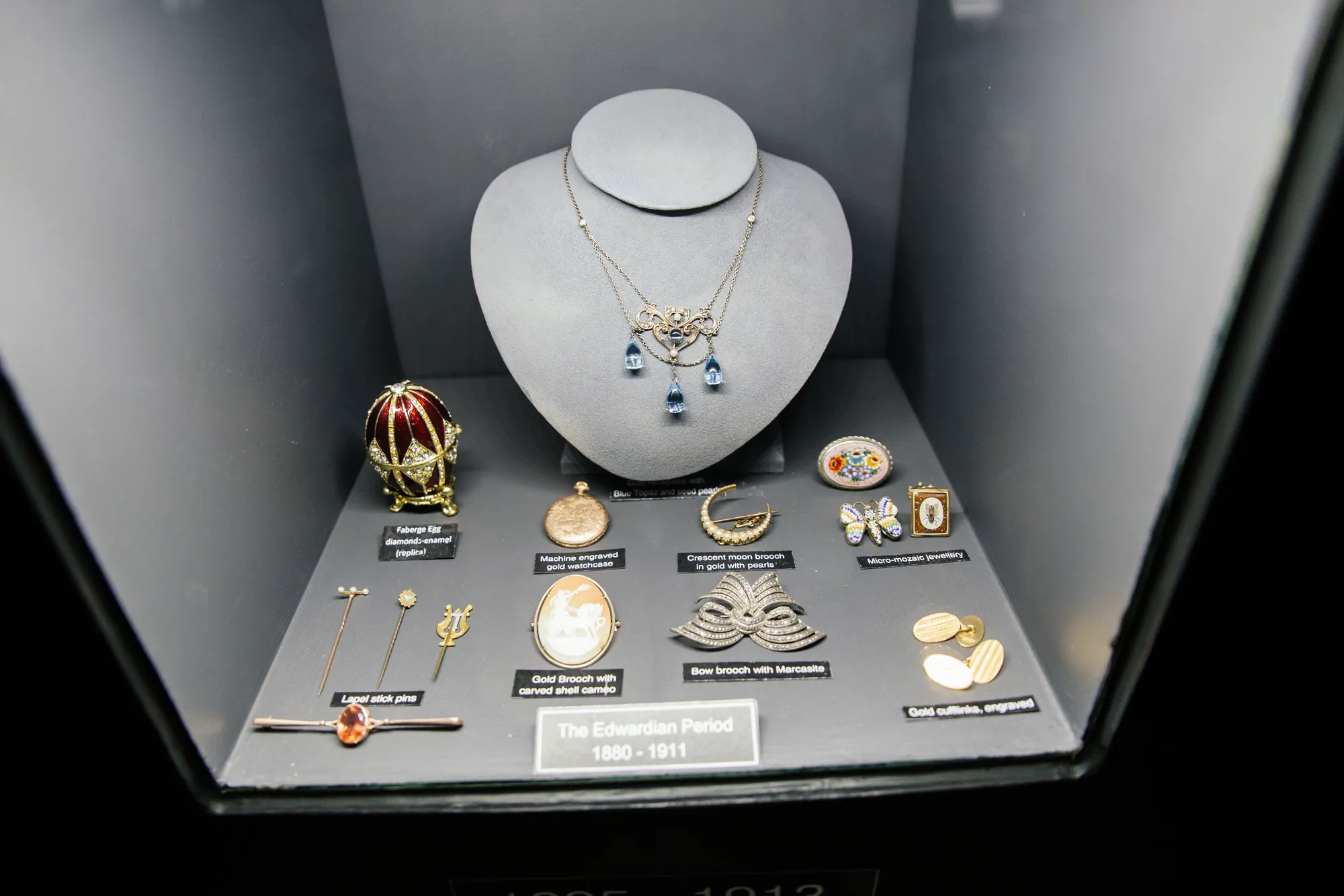
The Edwardian Period display case in the museum (1880 to 1911): gold necklace with blue topaz and seed pearls, Fabergé egg replica in diamonds-enamel, machine-engraved gold watchcase, crescent-moon brooch in gold with pearls, micro-mosaic jewellery, gold brooch with carved-shell cameo, bow brooch with marcasite, lapel stick pins and engraved gold cufflinks
Chapter III

1880  ◆  1911

The Edwardian Period
Light, lace and platinum.

The first era of platinum settings, milgrain edges and Belle Époque lightness. Court jewellers reached their technical peak just as the world rolled toward war. A short decade, a perfect one.

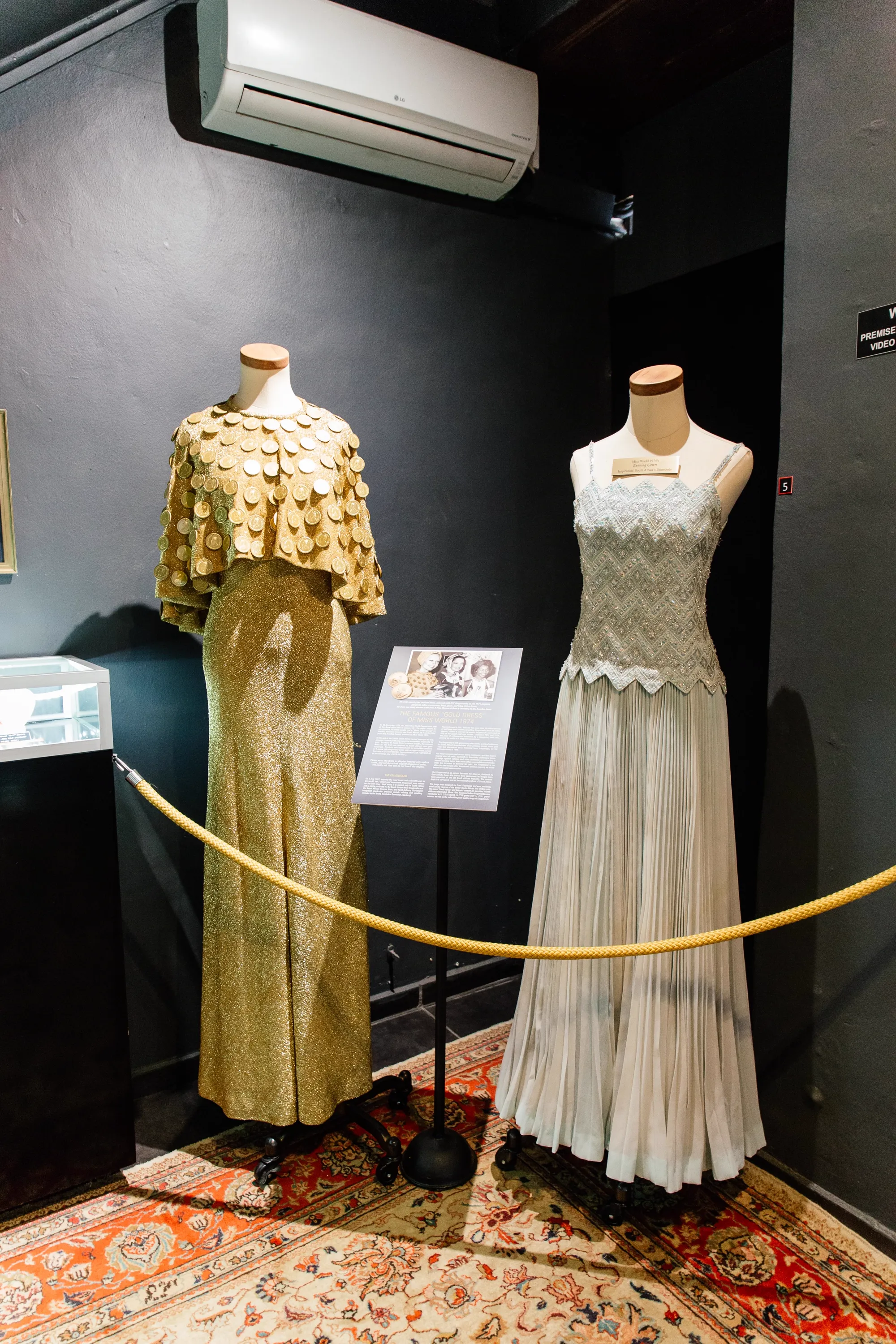
The gallery's gold-rope-cordoned plinth room in the museum: the Miss World 1974 Krugerrand gown on the left mannequin, Anneline Kriel's silver beaded evening gown on the right, both on a Persian rug under warm gallery lighting
Chapter IV

1920  ◆  1939

The Art Deco Era
Geometry, jazz and onyx.

Hard angles, lacquer-black onyx, calibré-cut sapphire and ruby, baguette diamonds and the first taste of modernist design at the bench. The first time jewellery looked like architecture.

Part Two  ·  The Cradle

Where craftsmanship was first invented.

The collection opens where the human hand first shaped a tool. Forty thousand years before the Georgian jeweller, southern African ancestors were carving, beading and casting.

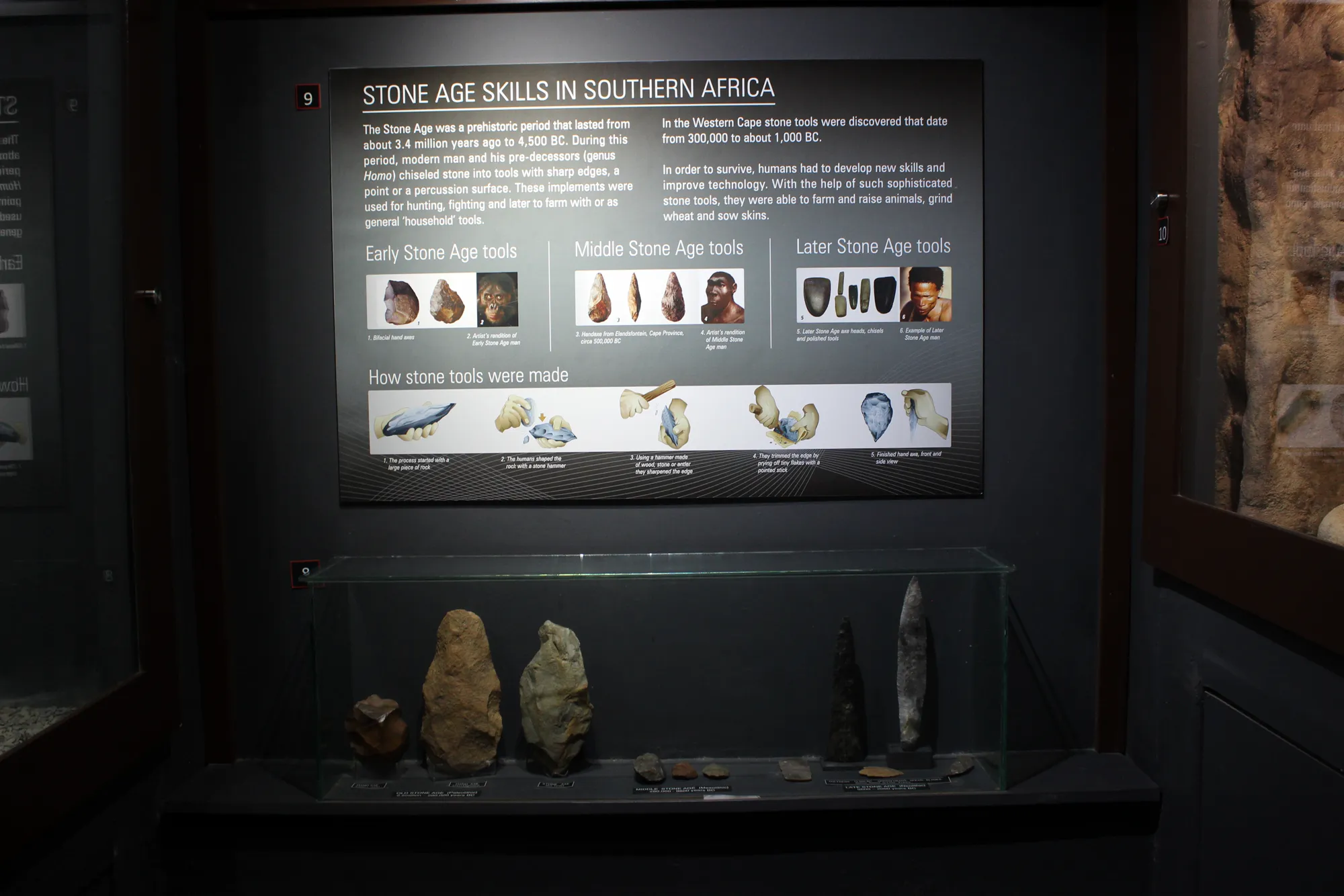
Stone Age tools display in the Prins and Prins museum: early, middle and later Stone Age hand axes, chisels and polished stone implements from the Western Cape
Chapter V

3.4 million BC  ◆  1,000 BC

Stone Age skills,
in southern Africa.

In the Western Cape, stone tools have been recovered that date from 300,000 to roughly 1,000 BC. The earliest evidence of human creativity sits in our opening cabinet: hand axes, points, hammers and polished implements that built every craft that followed.

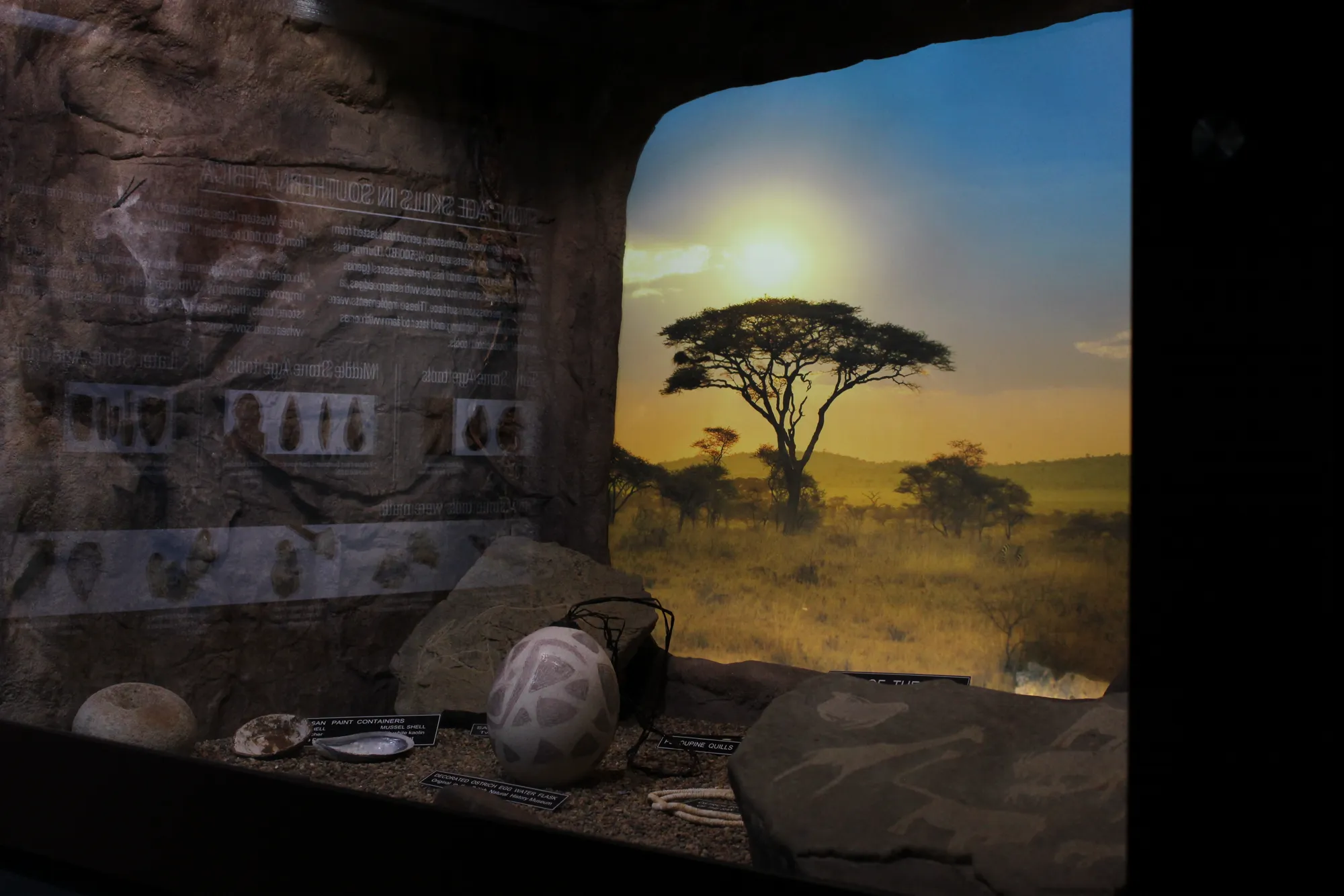
The Cradle of Creativity diorama in the museum: an African savanna scene with acacia silhouette, ostrich-shell flask, San paint containers and stone tools
Chapter VI

75,000 BC  ◆  The Latest Ice Age

The cradle of human creativity.

In 2011, the earliest evidence of human culture was discovered at Blombos Cave, near Mossel Bay. Decorated ochre, shell beads and pigment grinders, pushed the date of symbolic thinking back tens of thousands of years. Our diorama walks you into that Cave.

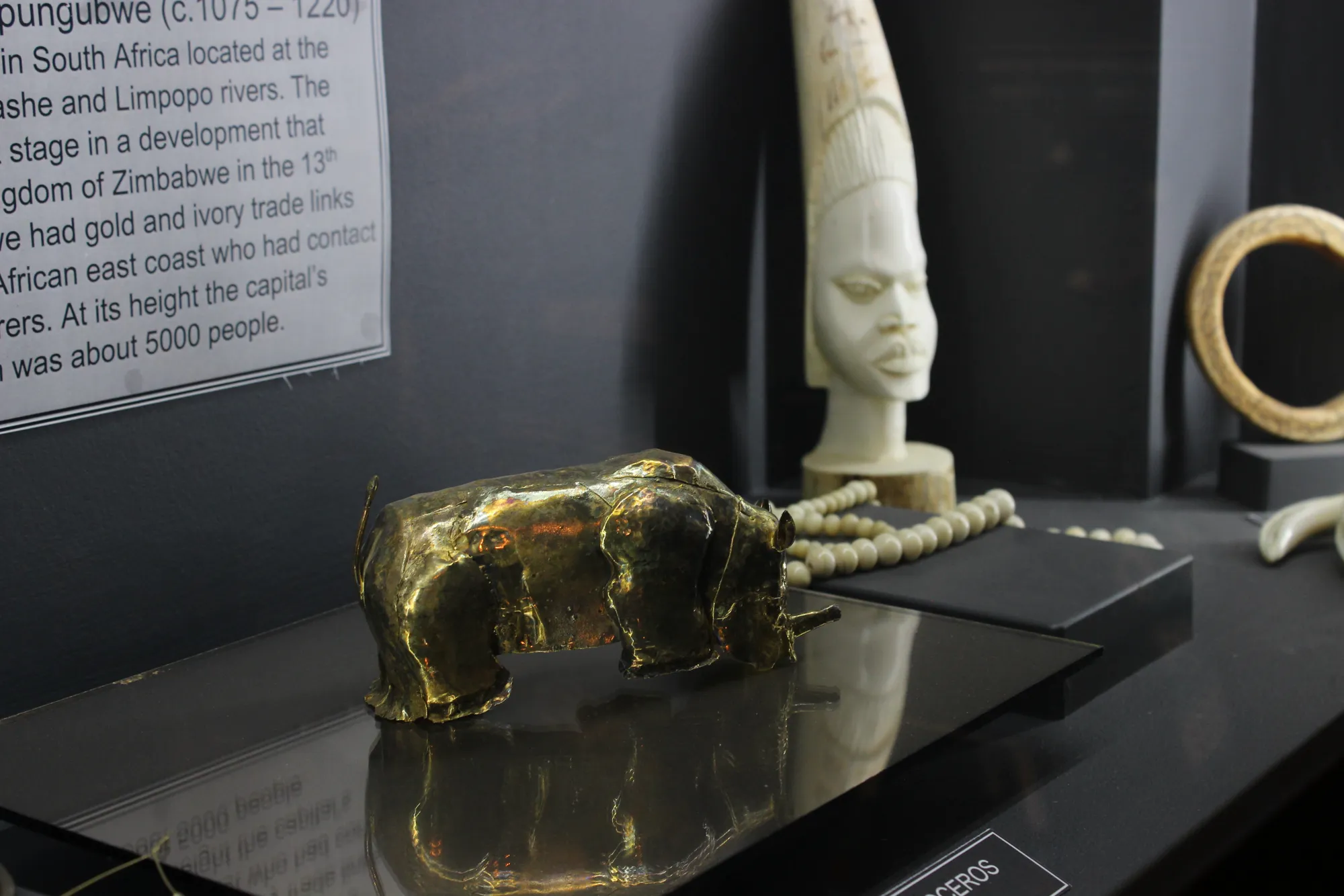
The Mapungubwe gold rhinoceros replica in the museum, alongside an ivory carved head and the heritage plaque describing the Limpopo iron-age kingdom
Chapter VII

c. 1075  ◆  1220 AD

Mapungubwe,
an iron-age kingdom.

An advanced kingdom on the Limpopo, trading gold and ivory east to Persia, India and China. In 1933 a royal grave on Mapungubwe Hill yielded the gold-foil rhinoceros, sceptre and bowl that are now South Africa's most famous archaeological objects. UNESCO World Heritage since 2003.

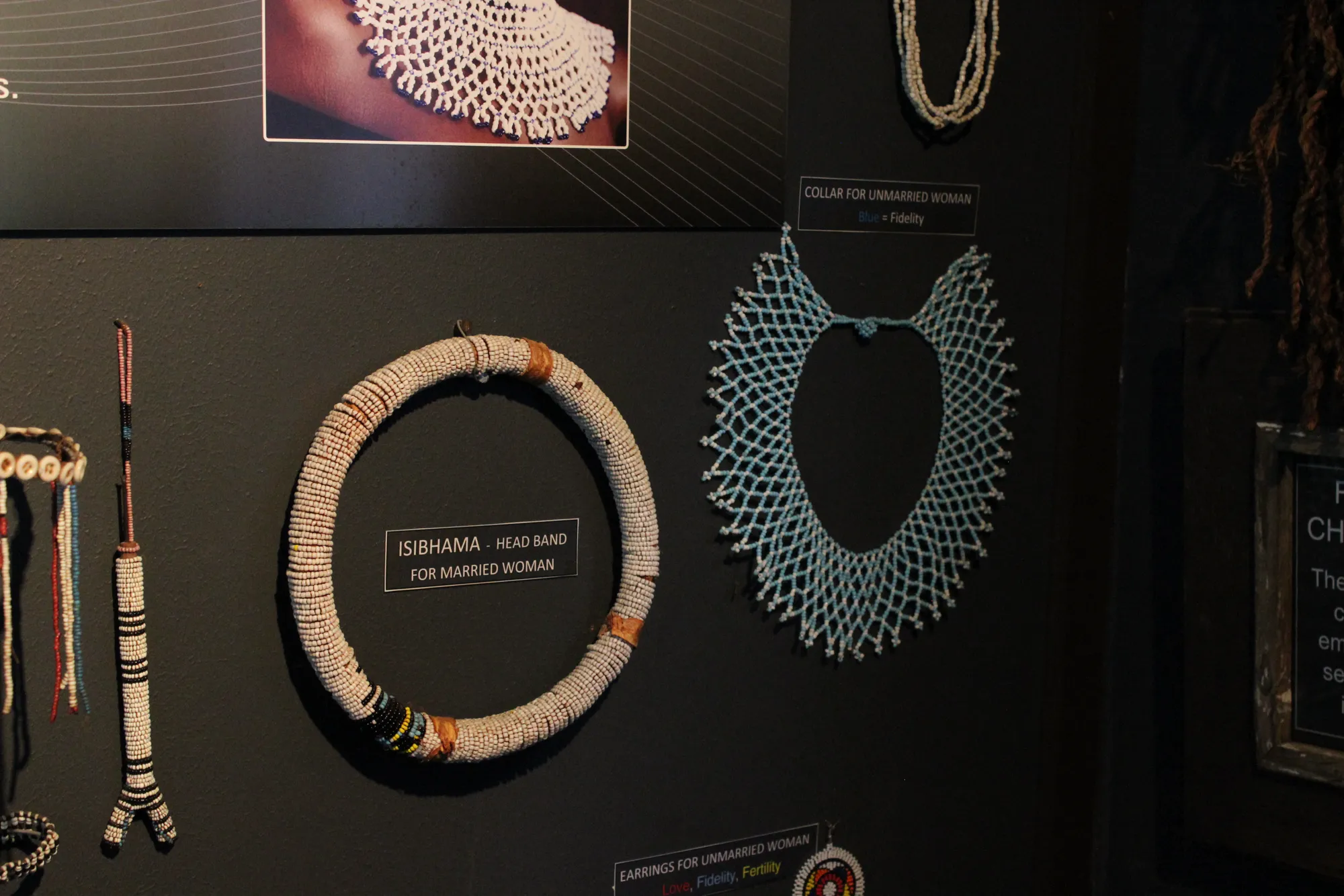
Traditional Zulu and Xhosa beadwork in the museum: the Isibhama head band for married women, collar for unmarried women, and earrings, all in symbolic colour
Chapter VIII

Zulu  ·  Xhosa  ·  Ndebele

The meaning of
African bead jewellery.

Seven colours, one triangle. Zulu maidens weave thoughts of love, jealousy and uncertainty into beaded courtship pieces. White next to blue means fidelity and true love, the traditional engagement pendant. Triangles point down for an unmarried woman, up for an unmarried man.

Part Three  ·  The Geology

How a country became a treasure chest.

Three billion years of geology. Diamonds, gold, platinum and the rare earths, explained in the cabinets exactly the way Dr Prins teaches them.

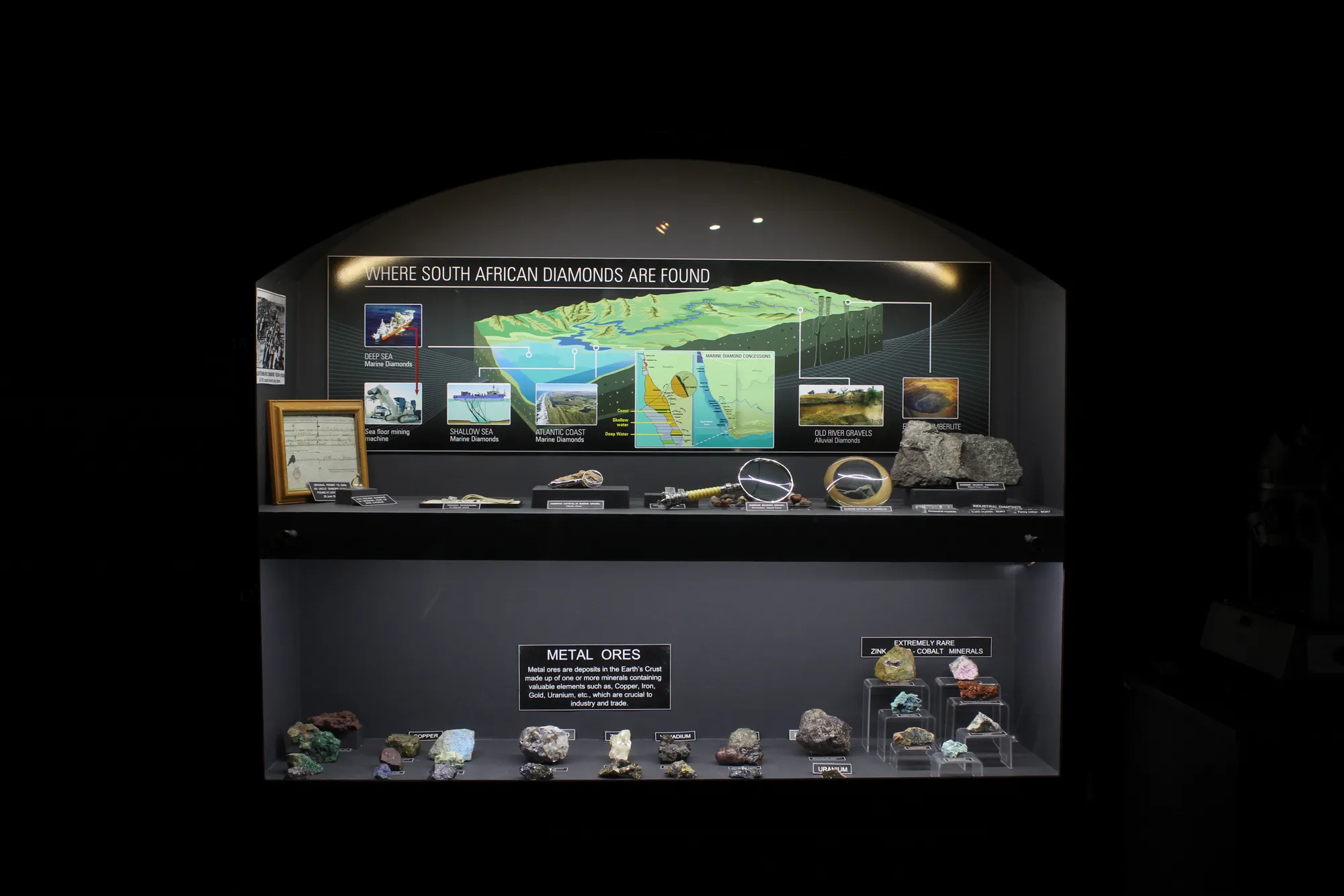
The 'Where South African Diamonds Are Found' display in the museum showing the four routes to surface, deep-sea mining, marine diamonds, alluvial old river gravels, and extinct kimberlite volcanoes
Chapter IX

~120 million years ago

Where South African
diamonds are found.

Four routes to the surface. Extinct kimberlite volcanoes at Kimberley, Cullinan and Koffiefontein. Alluvial gravels carried by old rivers. Marine concessions on the Atlantic coast. And the deep-sea mining vessels still producing today.

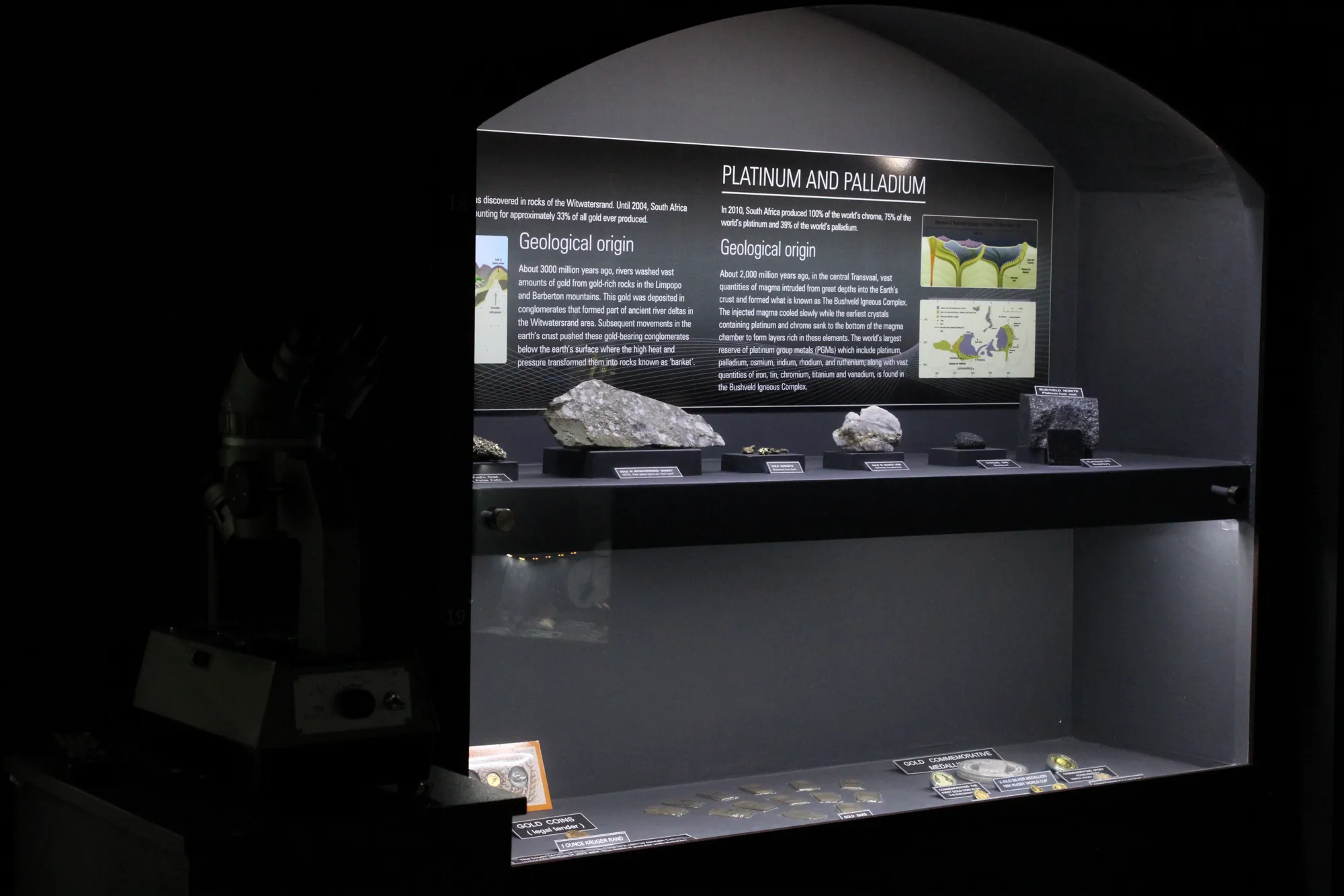
The Platinum and Palladium geological-origin display in the museum, with rock specimens from the Bushveld Igneous Complex and Witwatersrand 'banket'
Chapter X

2,000 million years ago  ◆  today

Platinum, palladium
and Witwatersrand gold.

In 2010, South Africa produced 100% of the world's chrome, 75% of the world's platinum and 39% of the world's palladium. The Bushveld Igneous Complex holds the largest reserve of platinum-group metals on earth, and the Witwatersrand ‘banket’ built the modern gold trade.

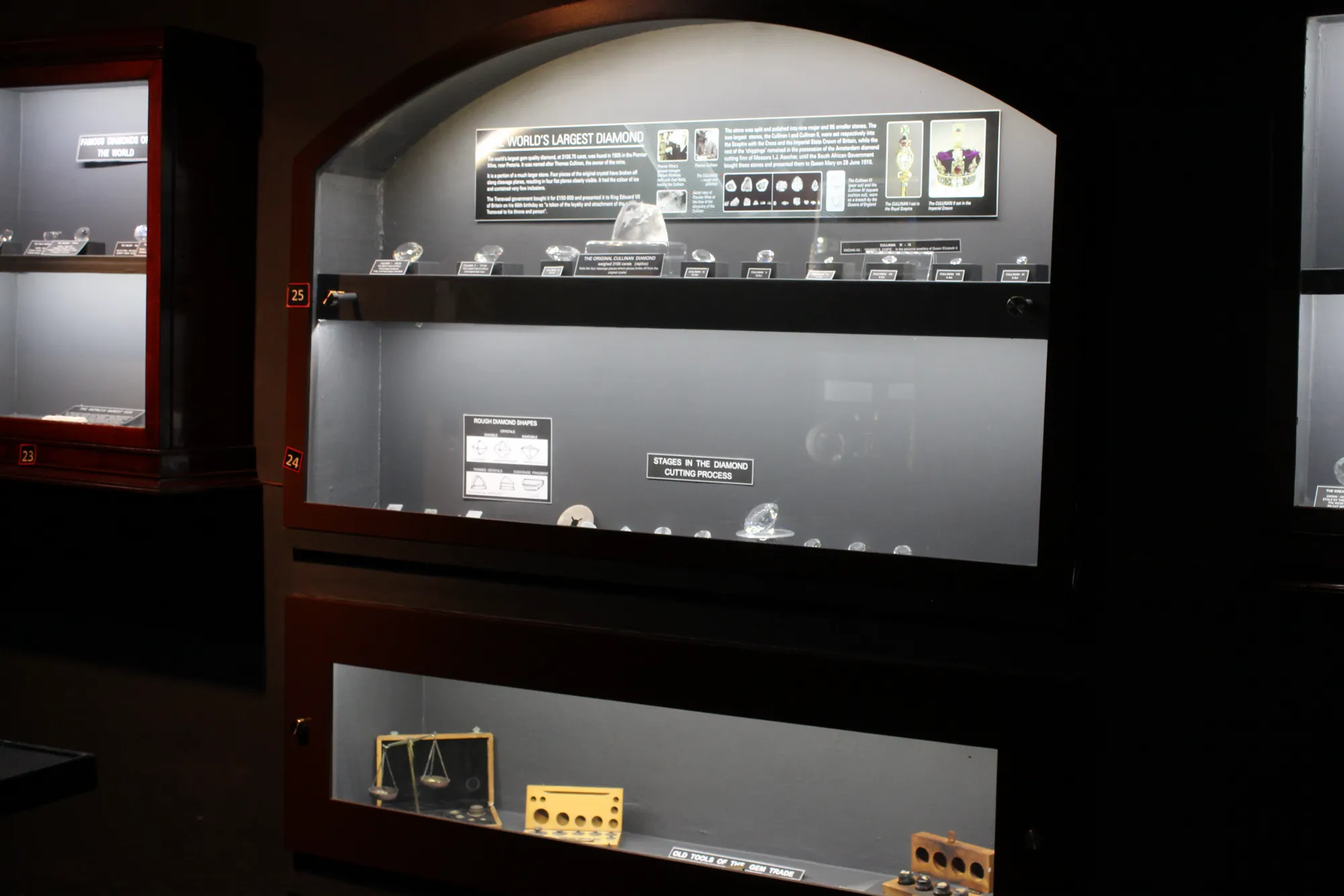
The World's Largest Diamond display in the museum: the Cullinan story, replicas of the original rough, the nine stones cut from it, and the British Crown jewels they became
Part Four  ·  A Hero Artefact

The Cullinan,
3,106 carats out of Pretoria.

The largest gem-quality diamond ever found, recovered in 1905 from the Premier Mine, near Pretoria. Now nine stones set into the British Crown Jewels. The whole story sits in a single cabinet.

The Transvaal government bought it for £150,000 and presented it to King Edward VII on his 66th birthday. Asscher of Amsterdam took two years to plan the split. The stone produced nine major stones (Cullinan I through IX) and 96 smaller ones. The two largest sit in the Sovereign's Sceptre and the Imperial State Crown.

3,106 ctRough Weight 9Major Stones 1905Premier Mine, Pretoria
The Craft of the Cutter

Six stages, one perfect stone.

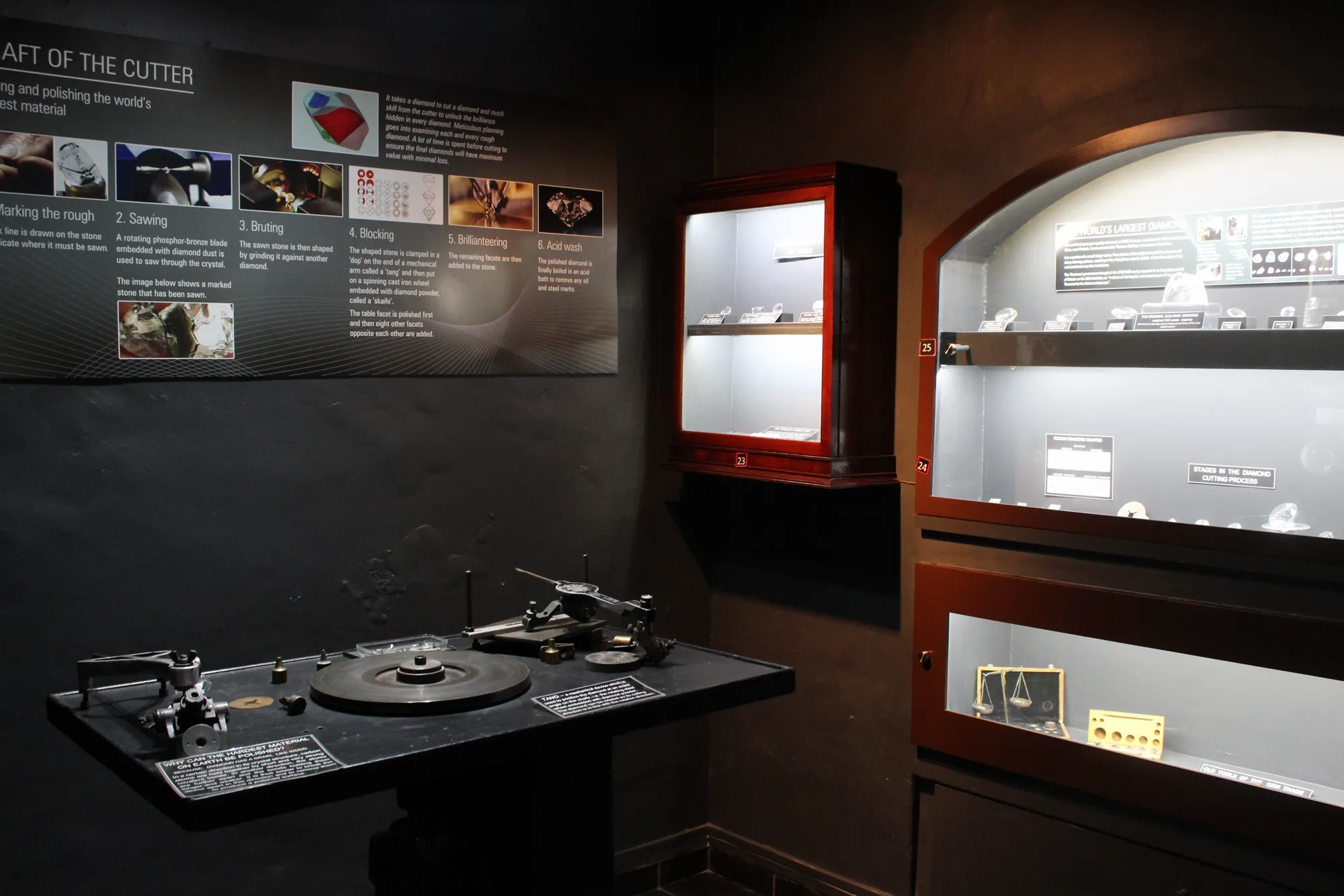
Marking, sawing, bruting, blocking, brillianteering, acid wash. The polishing of the hardest material on earth.

The diamond cutter's craft display in the museum: the six stages of cutting (marking, sawing, bruting, blocking, brillianteering, acid wash) with a working cutter's tang on the bench
Why can the hardest material on earth be polished?  ·  Click to read
Part Five  ·  The Material Cabinet

Eight specimens, eight chemical formulae.

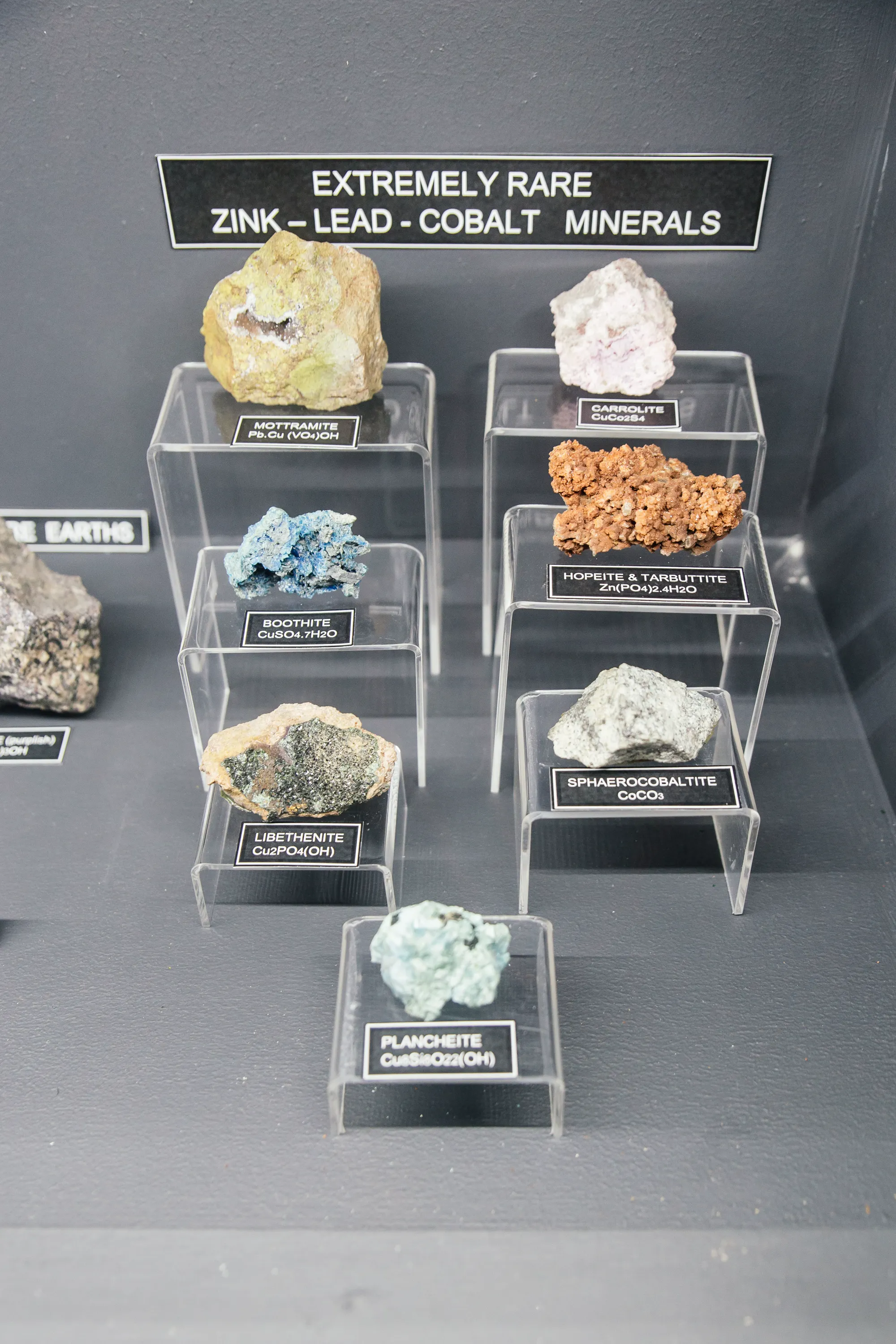
The rare zinc, lead and cobalt minerals that built southern Africa's gem economy. From the Copperbelt and Broken Hill mines.

The rare zinc-lead-cobalt minerals cabinet in the museum: eight specimens (Mottramite, Carrolite, Boothite, Hopeite, Tarbuttite, Libethenite, Sphaerocobaltite and Plancheite) labelled with chemical formulae on acrylic plinths
  1. Mottramite

    Pb.Cu(VO4)OH

    Lead-copper vanadate. Olive-green, rare. Oxidised lead deposits.

  2. Carrolite

    CuCo2S4

    Copper-cobalt sulphide. Silver-grey. Katanga Copperbelt.

  3. Boothite

    CuSO4 · 7H2O

    Hydrated copper sulphate. Deep blue. Forms in mine drainage.

  4. Hopeite & Tarbuttite

    Zn3(PO4)2 · 4H2O

    Zinc phosphates. Rust-orange. Broken Hill, Zambia.

  5. Libethenite

    Cu2PO4(OH)

    Copper phosphate hydroxide. Olive to dark green. Named for Ľubietová.

  6. Sphaerocobaltite

    CoCO3

    Cobalt carbonate. The pink comes entirely from cobalt. Kakanda, DRC.

  7. Plancheite

    Cu8Si8O22(OH)4

    Copper silicate hydroxide. Azure-blue. Tantara mine, Katanga.

  8. Plus rare earths

    REE · U · Zn · Pb

    Rare-earth, uranium, zinc and lead specimens on the same shelf.

Part Six  ·  The Stone Drawers

The rare colour phenomena of gems.

Specialty stones, organic gemstones, and the African colour parcels Dr Prins sourced directly from the mining regions.

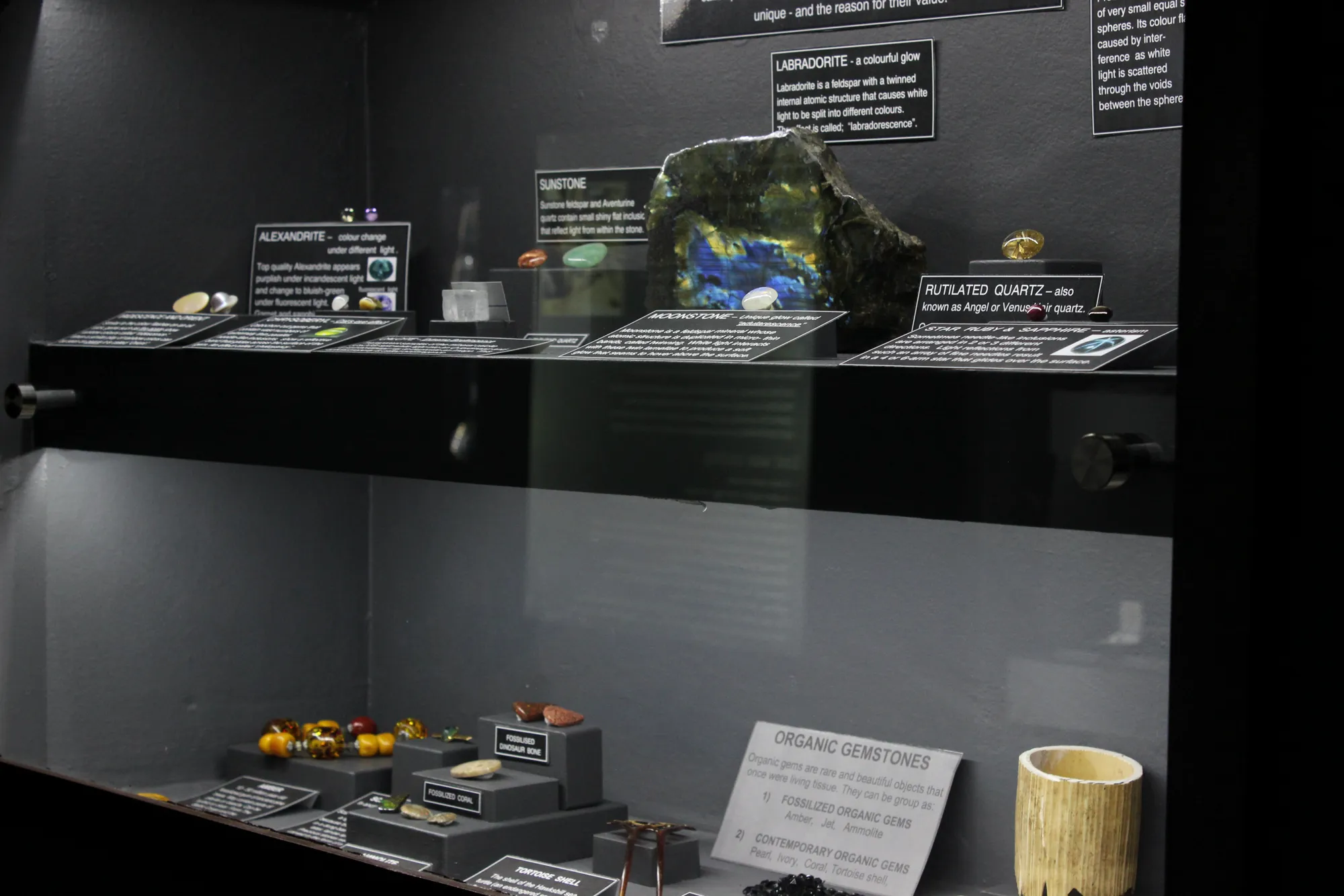
The specialty-stones cabinet in the museum: Alexandrite, Sunstone, Moonstone, Labradorite, Rutilated Quartz, Star Ruby and Sapphire on the upper shelf; fossilised organic gemstones, amber, ammolite, fossilised dinosaur bone, fossilised coral, tortoise shell, on the lower shelf
Chapter XI

Phenomena of light  ·  organic gems

Stones that change colour, glow and star.

Alexandrite that shifts from purple to bluish-green between light sources. Moonstone with its inner aqueous glow. Labradorite's twinned atomic structure splitting white light into spectral colour. Star ruby and sapphire with their needle-like rutile asterism.

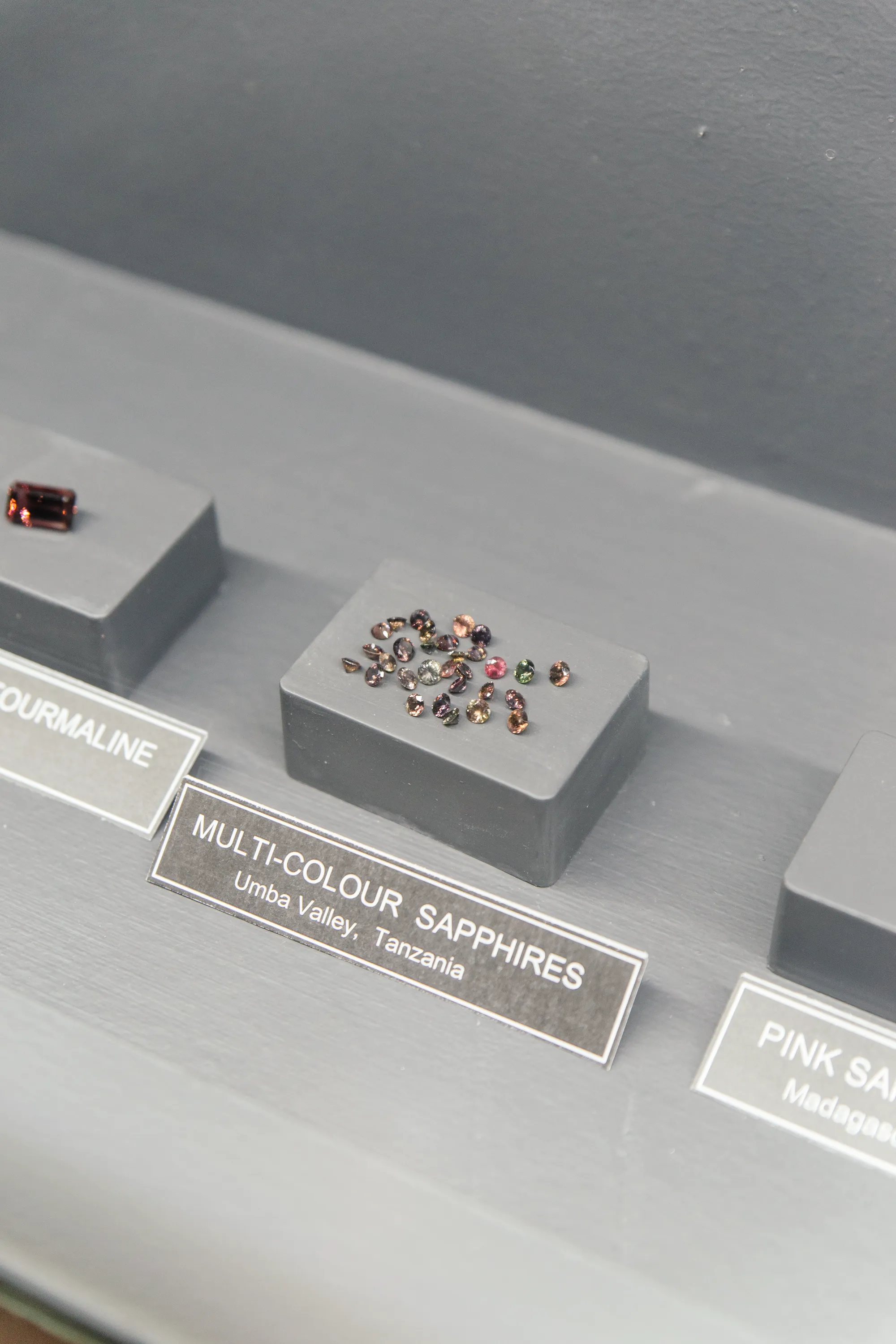
A parcel of multi-colour sapphires from the Umba Valley, Tanzania, on a black plinth in the museum, beside an emerald-cut tourmaline
Chapter XII

East Africa  ·  loose-stone trays

Multi-colour sapphires
from the Umba Valley.

The Umba River in northeastern Tanzania produces sapphires in a spectrum unrivalled anywhere on earth, violet, pink, orange padparadscha, green, yellow and the rare 'umba-grey'. Same corundum, different trace elements. The drawer holds a working parcel.

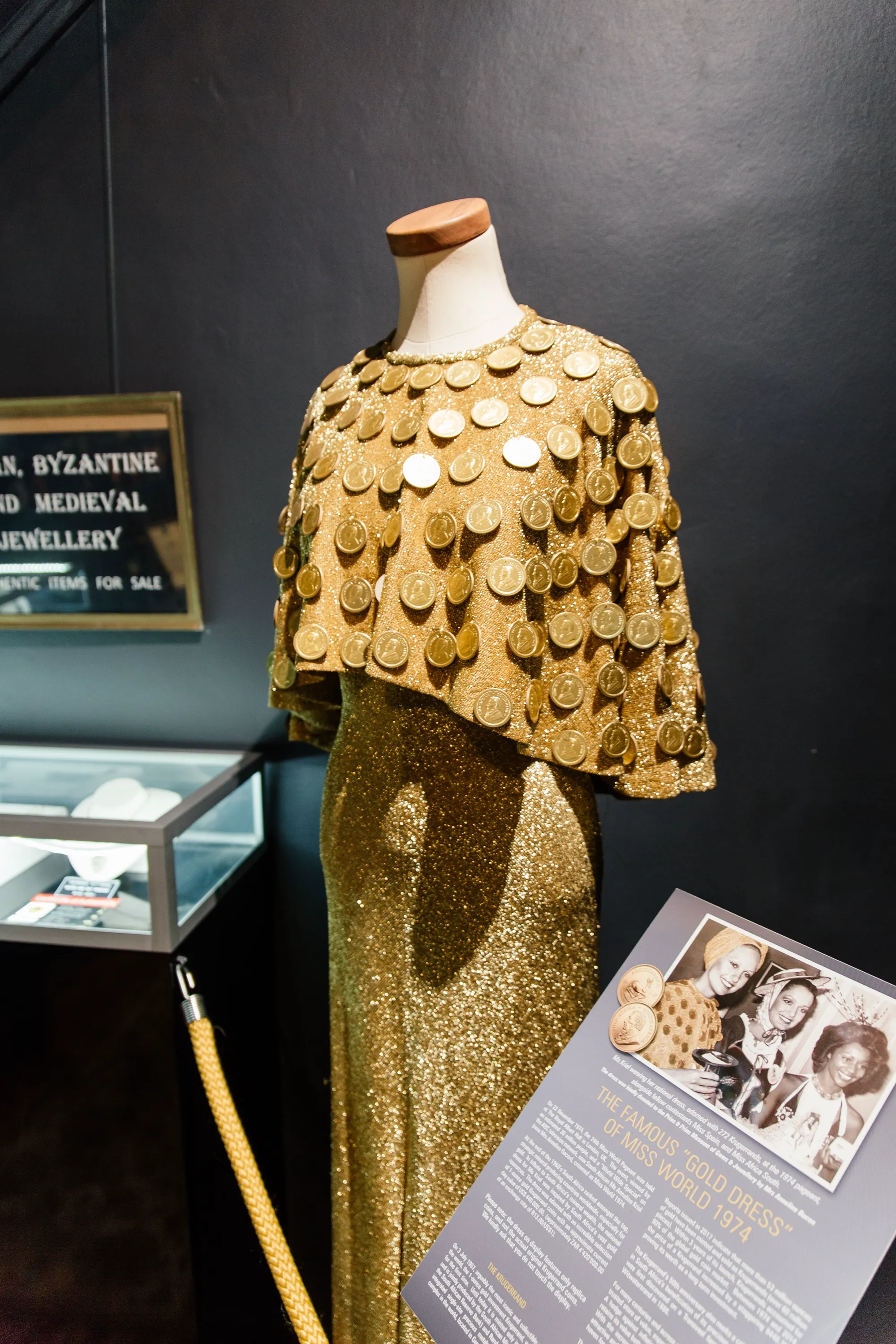
The Miss World 1974 Krugerrand gown on display in the museum, adorned with 272 replica Krugerrand coins, with the archival photograph of Anneline Kriel and the story plaque beside it
Part Seven  ·  A Hero Artefact

The Krugerrand Gown,
worn by Miss World 1974.

The most photographed dress in South African pageant history, now quietly held in our gallery, kindly donated to the museum by Anneline Kriel.

On 22 November 1974, at the Miss World Pageant, the winner Anneline Kriel, wore this dress adorned with 272 replica Krugerrands. The weight of real Krugerrands would have buckled her knees. The Krugerrand coin, launched a few years earlier, remains the world's most-sold gold coin, with over 50 million in circulation.

272Krugerrand Coins 1974Miss World Pageant
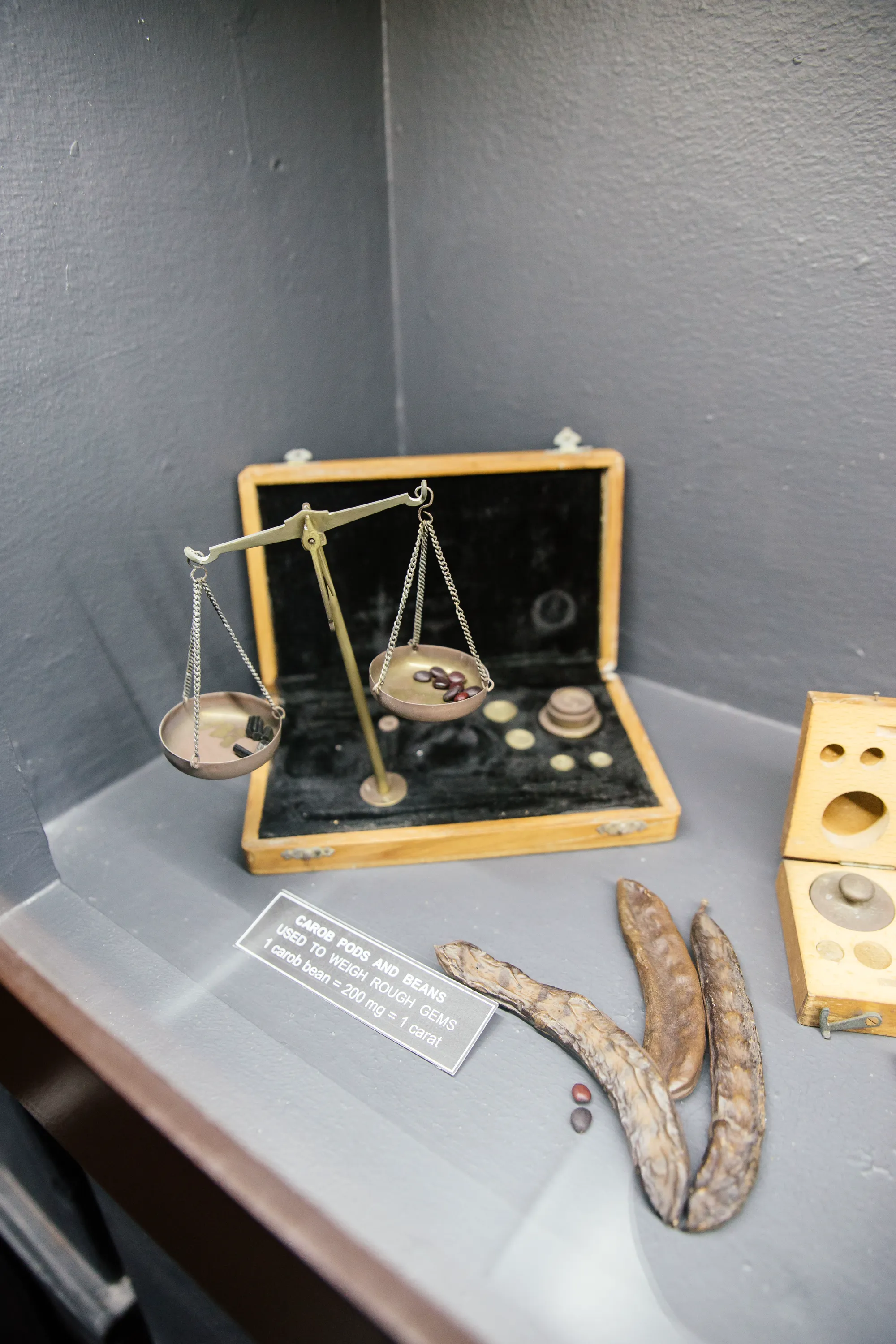
Antique brass jeweller's balance with carob pods and beans in the museum, and a brass calibrated weight set in a wooden case
An Origin Story

Two hundred milligrams.
One carob bean.

The unit that became the carat. The carob seed is so uniform in weight that ancient gem traders used it as their reference standard. The English word ‘carat’ is a direct loan from the Greek kerátion, the carob seed. Antique brass balances, calibrated weight sets and original dried pods on display.

Part Eight  ·  The Educational Cabinet

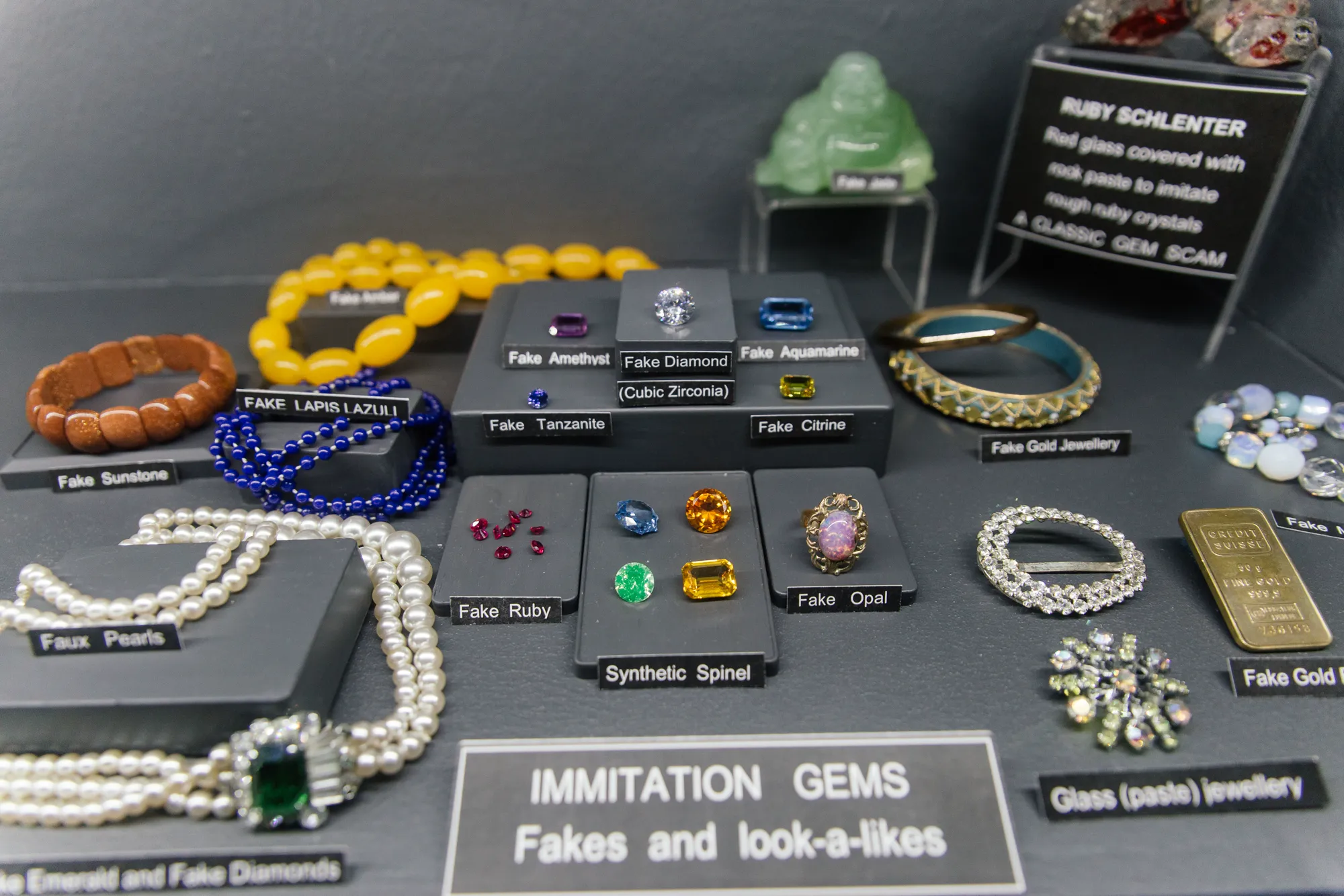
Synthetic gems, Imitations, Fakes and look-a-likes.

The educational cabinet that quietly upgrades the way you look at jewellery. Bring your own piece, Dr Prins will tell you.

The imitation-gems cabinet in the museum: synthetic spinel, cubic zirconia (fake diamond), ruby schlenter, fake amber, fake lapis lazuli, faux pearls, fake jade Buddha, fake gold bars and dyed beadwork laid out beside their natural counterparts
One of these gems is a diamond. The answer on a note to the left of the cabinet.
Part Nine  ·  The Bench Today

How jewellery is made.

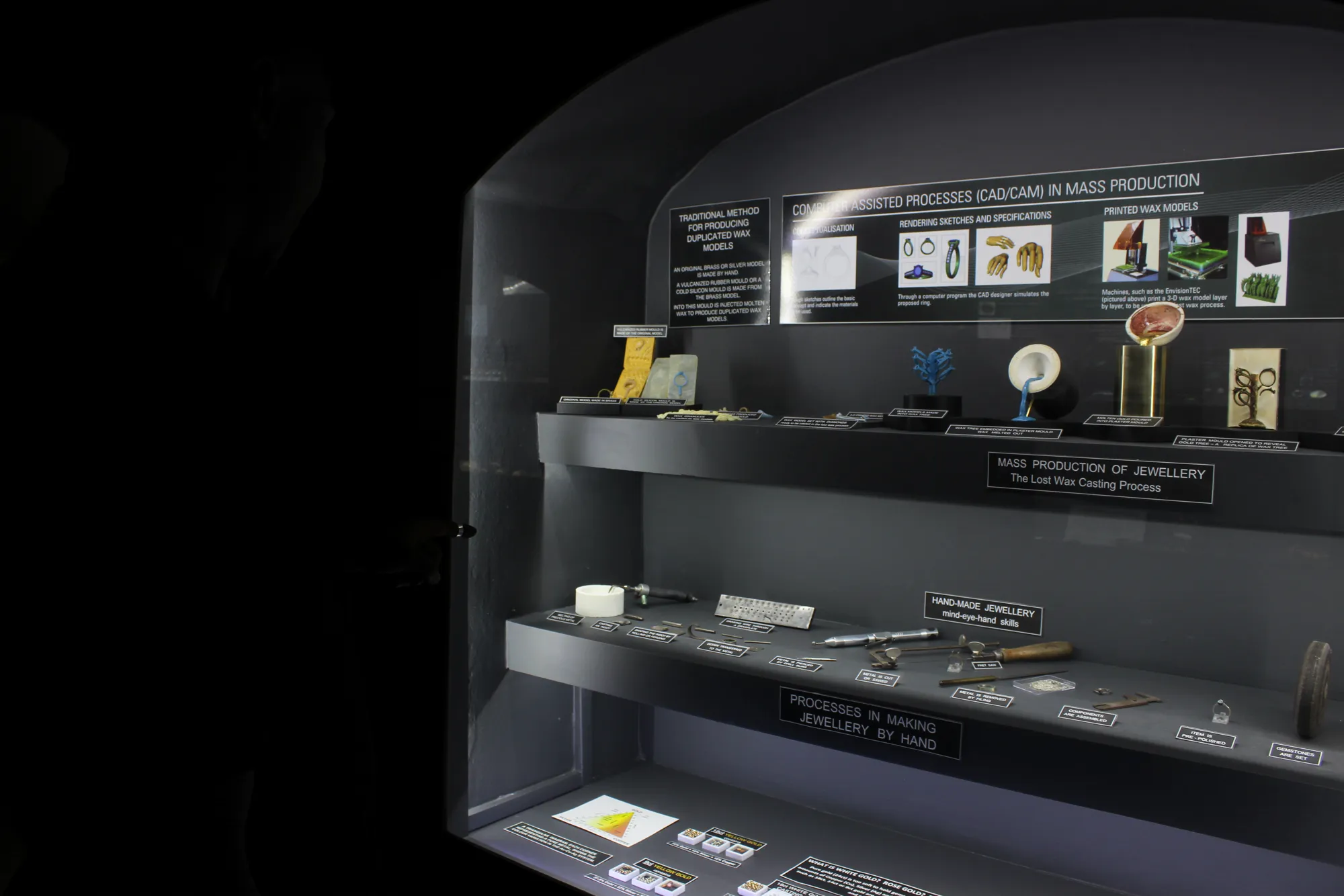
A working display of the two production techniques: computer-assisted (CAD/CAM) and lost-wax casting, versus hand-made using mind-eye-hand skills.

The Making Jewellery cabinet in the museum: the lost-wax casting process from CAD render through 3-D printed wax model, wax tree, plaster mould, molten gold pour and final polished ring, shown alongside the hand-made jewellery shelf with goldsmith's drawplate, files and tools
Chapter XIII

Two Techniques  ·  One Atelier

Computer Assisted
or By Hand.

See the different phases of CAD/CAM production, Lost Wax Casting, Stone setting and Surface finishing. On the middle shelf a display of centuries-old hand tools. On the lower shelf, the metal compositions of different precious metal alloys are visually displayed.

Book a Tour or Private Viewing